Rembrandt Peale
G.56.4.1
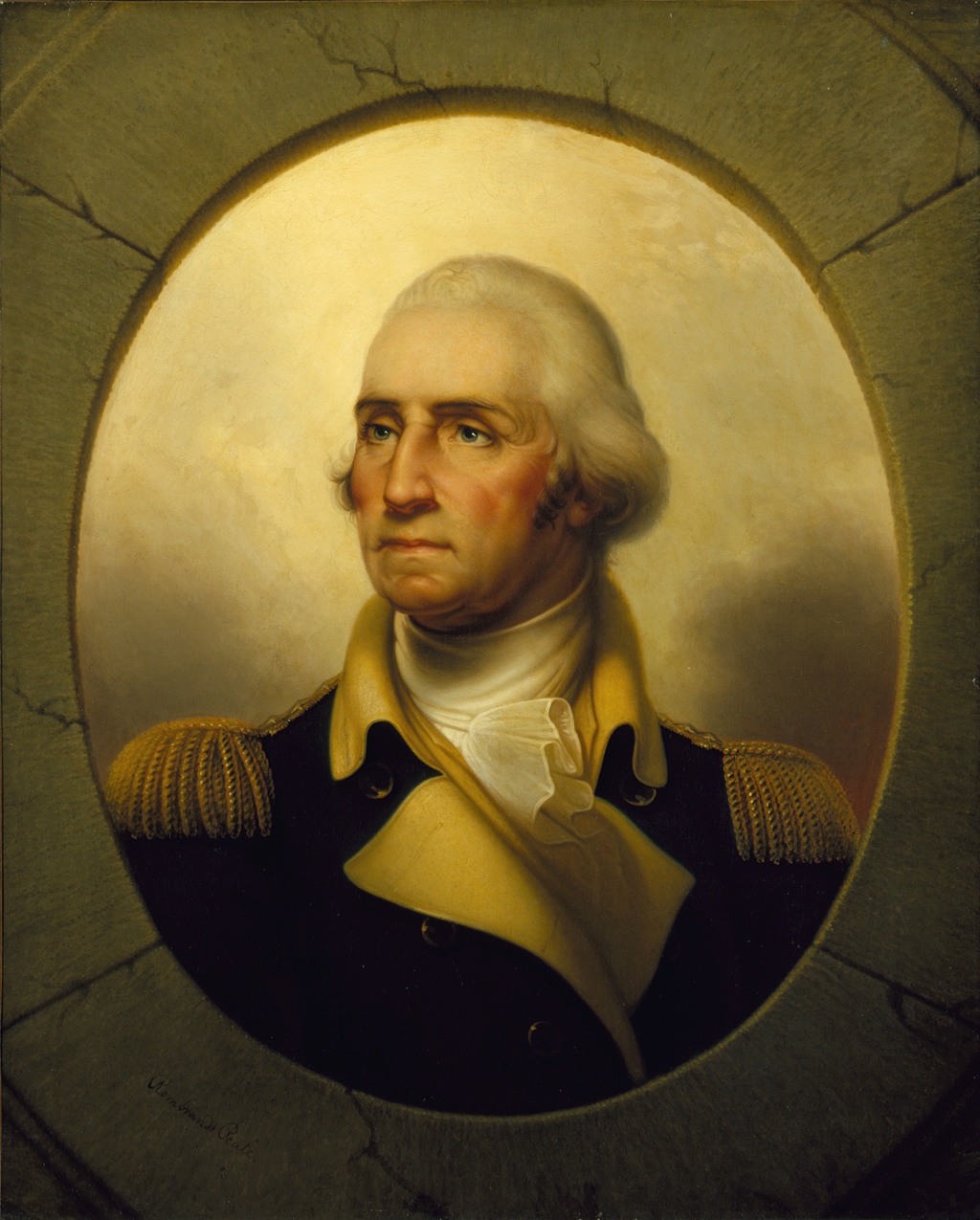
Rembrandt Peale was 17 when he painted his first portrait of George Washington.
This oil painting is also known as the “porthole” portrait because of the oval shape that surrounds Washington. The painted oval looks like it is made of real stone. The artist created this illusion with a European painting technique that tricks the eye.
This portrait is an example of Peale’s “standard national likeness” of Washington. He painted 79 versions of it.
Peale’s work was influenced by French neoclassicism. Neoclassical paintings focus on the ideal human form. Peale depicted George Washington in a more flattering way than he looked in real life.
Washington’s legacy is complicated by his involvement in taking the land of Indigenous people and enslaving hundreds of African people.
Rembrandt Peale was 17 years old when he first painted George Washington from life (in person, rather than from an existing image). The artist’s father, Charles Willson Peale, had previously painted Washington. He asked the president if his son could also paint his portrait. Washington agreed to three sittings of three hours each.
This painting of Washington is known as the “porthole” portrait. It features a stone oval frame that surrounds his image. This framing style was popular in 17th-century European art. The artist created the illusion of stone with a painting technique known as trompe l’oeil (French for “deceive the eye”). This framing style, along with Washington’s noble pose and perfected facial features, makes him look strong and heroic. Peale’s work was influenced by French neoclassicism. This art movement was a revival of classical antiquity (the art and culture of ancient Greece or ancient Rome). Neoclassical paintings focus on the ideal human form rather than a true-to-life depiction of a person.
Years after Washington’s death, Rembrandt Peale combined many different images of him into a single portrait. He called it a “standard national likeness” of Washington. It was more of an icon than a realistic portrait. Peale painted 79 versions of the portrait between 1824 and 1860.
Many artists created portraits of Washington during the early years of the American Republic. Peale meant for this portrait to highlight Washington’s best qualities, such as courage and patriotism. Washington led the American Revolutionary War, and he kept the country united as the first president. Washington’s legacy, however, is complicated. He was involved in using military force to take land from Native Americans. He also owned hundreds of enslaved African people over the course of his life.
tags: US History, power, identity, impact, function, force, artist’s process
Gift of Mrs. Charles Lee Smith, Sr., William Oliver Smith, Charles Lee Smith, Jr., and Mrs. Joseph H. Hardison, in memory of Dr. Charles Lee Smith, Sr.
circa 1855
36 × 29 inches (91.4 × 73.7 centimeters)
Paintings
American to 1910