Artist

Louis Rémy Mignot

Nationality
American
Birth/Death
1831-1870

Learn More

Artwork by Louis Rémy Mignot
Work of Art
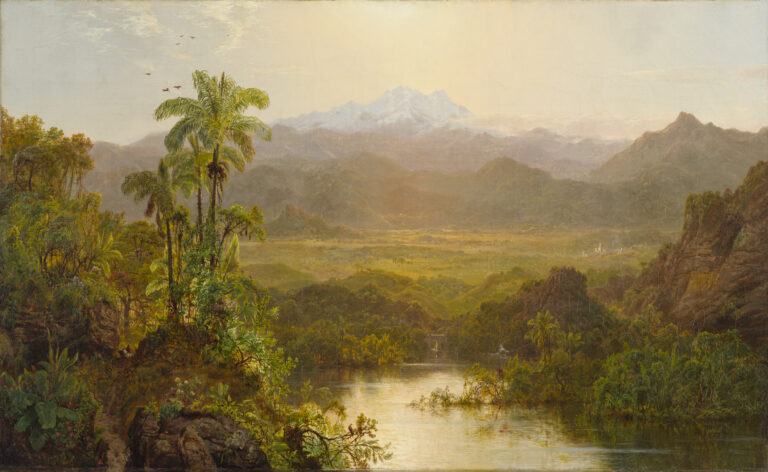
Landscape in Ecuador

About

Louis Rémy Mignot was a 19th-century American painter. He was born in Charleston, South Carolina. He was the only Southerner among the Hudson River School. Hudson River School painters created detailed, realistic-looking landscapes. Their art was influenced by romanticism, an art movement that encouraged the appreciation of nature. Mignot joined fellow painter Frederic Church on a four month trip to Ecuador in 1857. Church focused on painting the Andes mountains, while Mignot was drawn to the low-horizon river landscapes. He created many travel sketches during this trip that he later used to compose landscape paintings. Following the outbreak of the Civil War in the United States, Mignot raised money by selling his artwork and moved to England in 1862. He set up an art studio in London and traveled between London and Paris to work and exhibit. His work was accepted into the 1870 Paris Salon. Mignot fled France in 1870, at the beginning of the Franco-Prussian War. He went back to England and died from smallpox at age 39.

From Wikipedia

source content
Louis Rémy Mignot (February 3, 1831 – September 22, 1870) was an American painter of French Catholic descent. Associated with the Hudson River School of landscape artists, his southern US heritage and the influence of his time spent in Europe gave him a distinct style within that group, in painting vegetation and atmospheric effects. Mignot's parents came to the US from France after the Bourbon Restoration in 1815. Mignot pursued his interest in art in Europe beginning in 1848, and spent much of his life outside the US. Starting in 1850 he worked for four years in Andreas Schelfhout's studio in The Hague, Netherlands, then travelled in Europe. Returning to New York City, he soon travelled with artist Frederic Edwin Church to Ecuador in 1857, gathering material for his paintings of the tropics, the subject of a large portion of his subsequent work. In 1858 he had a studio at…