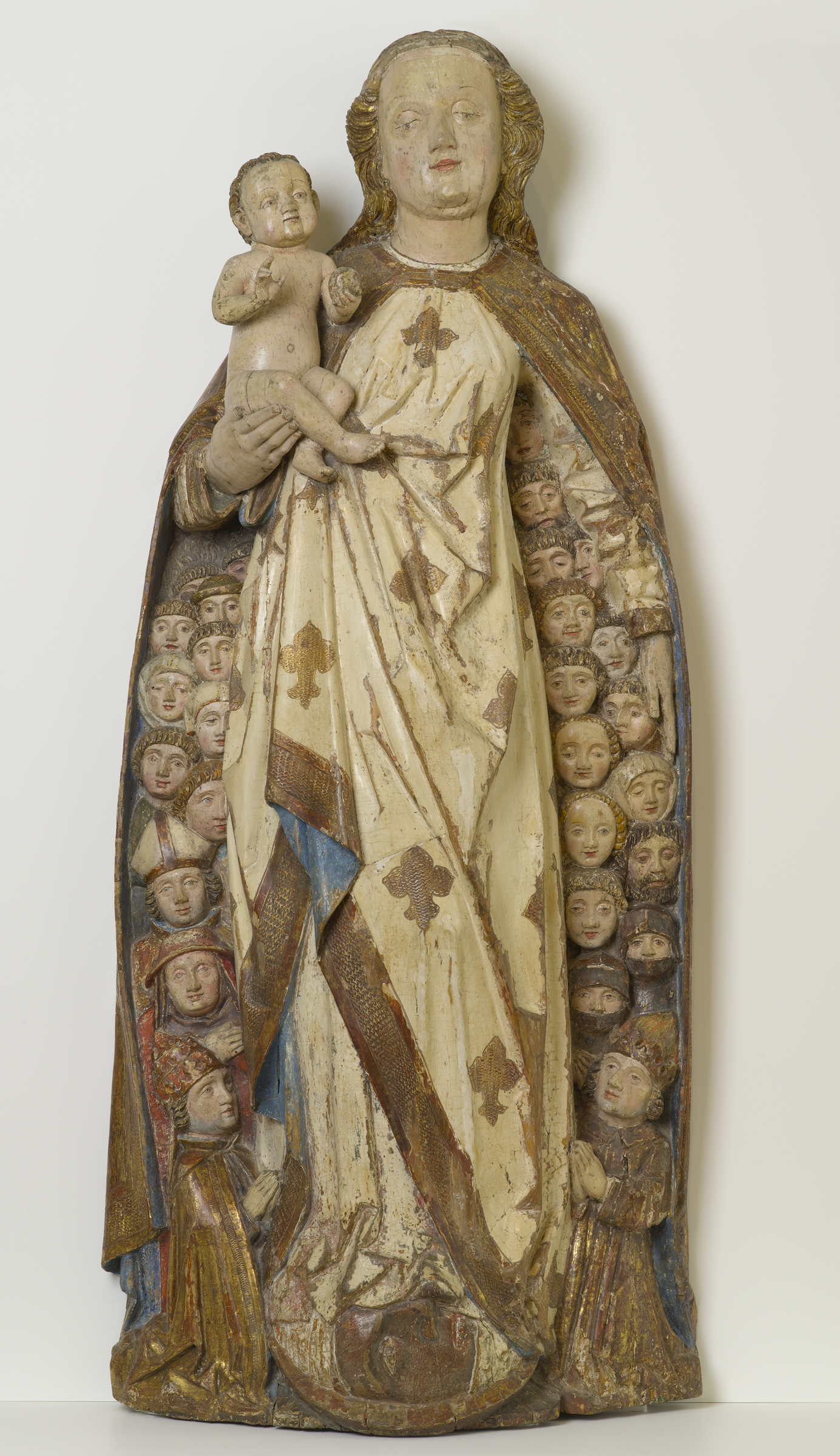
The image of the Virgin Mary protecting faithful Catholics under her cloak is known as the “Madonna of Mercy.” The term refers to the Virgin Mary’s role in Catholic theology as an intercessor, or someone who intervenes on behalf of another, especially by prayer. She is always ready to plead to Christ for mercy on behalf of those in physical or spiritual distress. In the Middle Ages, the Madonna of Mercy was popular among members of monastic orders (monks) as well as charities made up of men with nonreligious jobs.
This sculpture depicts the Virgin Mary sheltering members of the spiritual estate on one side of her cloak: a pope, a cardinal, and a bishop can be identified by their distinctive hats. On the other side are members of the secular estate, including an emperor and knights. Held up high against his mother’s chest and shoulder, the Christ Child makes a gesture of blessing and holds an apple. The apple symbolizes his role as the “New Adam” who saves humankind from the consequences of sin.
Mary’s white gown is lined with blue and decorated with gold fleurs-de-lis (lily flowers) as symbols of her purity. She stands on a crescent moon covered in a layer of silver leaf. Most of the silver leaf has worn away, revealing a layer of red paint beneath the metal. The moon symbolizes Mary’s role as the Queen of Heaven. It also represents the vision of the “Apocalyptic Woman” described in the Revelation of St. John: “A great portent appeared in heaven: a woman clothed with the sun, with the moon under her feet, and on her head a crown of twelve stars” (Revelation 12:1).
tags: symbolism, pattern, ritual, power, order, meaning, interdependence