
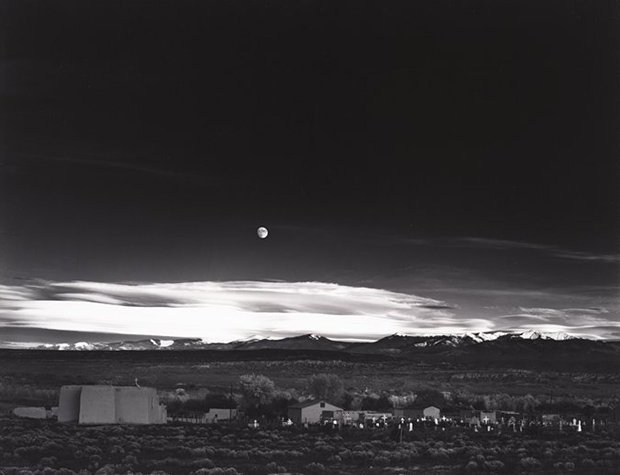
Moonrise, Hernandez, New Mexico (work of art)
Artwork Info
Key Ideas
- Ansel Adams is best known for creating black-and-white photographs of the American West. He became famous for his high-contrast landscape images.
- Adams’s photographs required careful planning and patience. He used large, heavy cameras that took time to set up. He could not instantly see his photos or take many quick shots like we can today.
- This is one of Adams’s most famous images, and it happened by accident. While he was working for the U.S. Department of the Interior in 1941, he captured a glowing sunset scene in Hernandez, New Mexico. When he tried to photograph the scene again, the sunlight had disappeared.
Learn More
Ansel Adams was an American photographer and environmentalist who created high-contrast, black-and-white photographs of the American West. He used large-format field cameras to make his famous landscape photographs. These cameras were much bigger and heavier than the cameras and phones we use today. Instead of snapping a quick picture, Adams had to set up a tripod, carefully adjust the focus, and place a large sheet of film inside the camera.
Each photo took time and planning. Adams had to measure the light, choose the right settings, and sometimes wait for the perfect moment. Unlike today’s digital cameras, he couldn’t see the picture right away or take hundreds of shots. Every photograph required patience, skill, and careful preparation.
Adams came across this scene by chance, while he was driving through New Mexico. According to the story he told later, he realized he had captured something special. He tried to make another negative of the same scene, but the lighting had already changed. The setting sun had reflected off the white crosses in a cemetery, creating their bright glow. By the time he tried to take the photo again, the sun had already set, and the effect was gone.
I was coming back to Santa Fe after a futile day [photographing] up in the Charma Valley, and I looked out the window of the car and here was this scene. Well, this is extraordinary! So I practically ditched the car. And I had some companions with me and I started yelling, “Get me the 8 x 10! Get me the tripod!”. . . Meantime the sun was going down behind clouds in the west, and I was getting panicky, you know. And I couldn’t find the exposure meter. So the only way I was able to control [the light]… well, I happened to know how bright the moon was in terms of candles per square foot: 250, approximately . . . so I could figure the exposure. And I said, “I’ve got a picture!”
Ansel Adams
In 1941 the U.S. Department of the Interior hired Adams to photograph national parks and monuments in the American West for a mural project. He photographed many iconic locations for the project, including the Grand Canyon, Yosemite, Yellowstone, Glacier, and Carlsbad Caverns National Parks. Adams captured this image of Hernandez, New Mexico during one of his work trips for the government’s mural project.
tags: atmosphere, black and white, time, place, landscape, clouds, mountains, southwest, nature, light, environment, ecology
Additional Resources
Resources for Teachers
- Visit a website to read articles about the life and career of Ansel Adams.
- Explore an educator guide from the Portland Art Museum that includes Ansel Adams lesson plan ideas.
- Watch a documentary film about Adams.
Resources for Students
- View a slideshow of Adams’s photographs from the mural project he completed for the Department of the Interior Building in Washington, DC.
- Explore a virtual gallery of landscape photographs by Adams.
- Watch a short video of Adams describing his artistic process.
Images
-
Moonrise, Hernandez, New Mexico