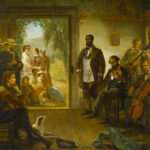
The Musicale is one of the earliest American paintings to portray an integrated musical group. It is also notable for its depiction of African American people in a way that does not exaggerate or distort their features. This was unusual in American art during the 19th century, when minstrel shows and derogatory racial stereotypes were common.
The painting depicts a string band performing in the barbershop of the Trenton Falls Hotel, a summer resort in upstate New York. The barbershop, which was located in a separate building on the hotel grounds, was a male-only space. In the painting several men are shown inside the shop, watching the band perform. A group of women has gathered to watch from outside. The man standing near the doorway is the hotel’s barber, William Brister, who was known for his singing. The artist also depicted himself in this scene; he’s the man holding a sketchbook. His wife is among the women outside the shop.
Thomas Hicks was a successful and fashionable artist in New York City in the 1800s. He was skilled at capturing the likeness and personality of his subjects. He sometimes included props in his paintings that represented his subject’s interests. Hicks is best known for painting the first oil portrait of Abraham Lincoln in 1860, before he became president. Hicks painted portraits of many other celebrities of his time. These include poet Henry Wadsworth Longfellow and author and abolitionist Harriet Beecher Stowe. Hicks also painted landscapes, historical and religious subjects, and genre scenes like The Musicale.
A genre scene, or genre painting, depicts moments from everyday life. Genre paintings often show ordinary people engaging in their daily activities. The scenes can be realistic or imagined. Some genre paintings communicate social or moral messages.