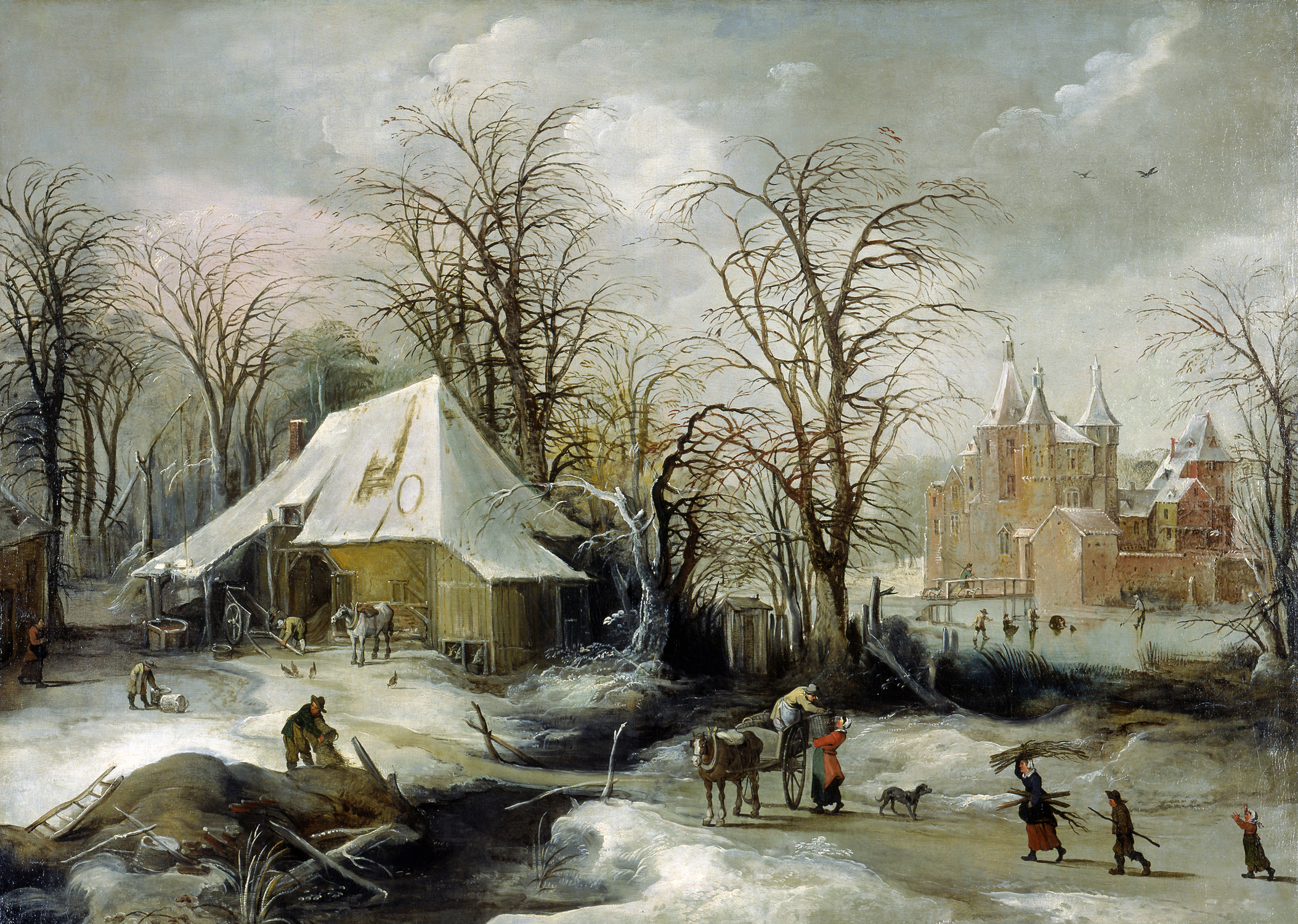
Winter Landscape depicts a scene of rural life in Flanders around 1625 to 1630. Flanders is the northern, Dutch-speaking region of Belgium that borders the Netherlands and the North Sea. In the details of this landscape scene, people and farm animals are actively engaged in daily life and winter activities. In the background, one human figure is shown playing kolf, a game that is similar to golf. Kolf was especially popular on the frozen rivers and canals of Flanders and the Netherlands.
Joos de Momper II, also known as Joos de Momper the Younger, was a Flemish landscape painter in Antwerp, Belgium. He was a successful artist in Antwerp in the late 1500s and early 1600s. During the 1600s, baroque art (also known as Flemish baroque) was popular in the Southern Netherlands. Baroque art is characterized by its dramatic style and realism. Key features of baroque art include vibrant colors and chiaroscuro, or strong contrasts of light and shadow.
De Momper’s work bridged the gap between the mannerist style of the 16th century and the more naturalistic landscapes of the 17th century. Naturalistic art depicts subjects with high accuracy and detail, aiming to represent them as they appear in the natural world. In his earlier paintings, de Momper used bright, artificial colors. In Winter Landscape, he painted with more natural colors and created realistic-looking depictions of nature. The rapid brushstrokes he used in this painting enhance the realism of its details.
One of de Momper’s biggest influences was Pieter Brueghel the Elder, who often painted mountain landscapes and winter scenes. De Momper was also influenced by Jan Brueghel the Elder. They worked together to create many paintings. De Momper painted the landscape while his collaborator painted the human figures, animals, and other small details.