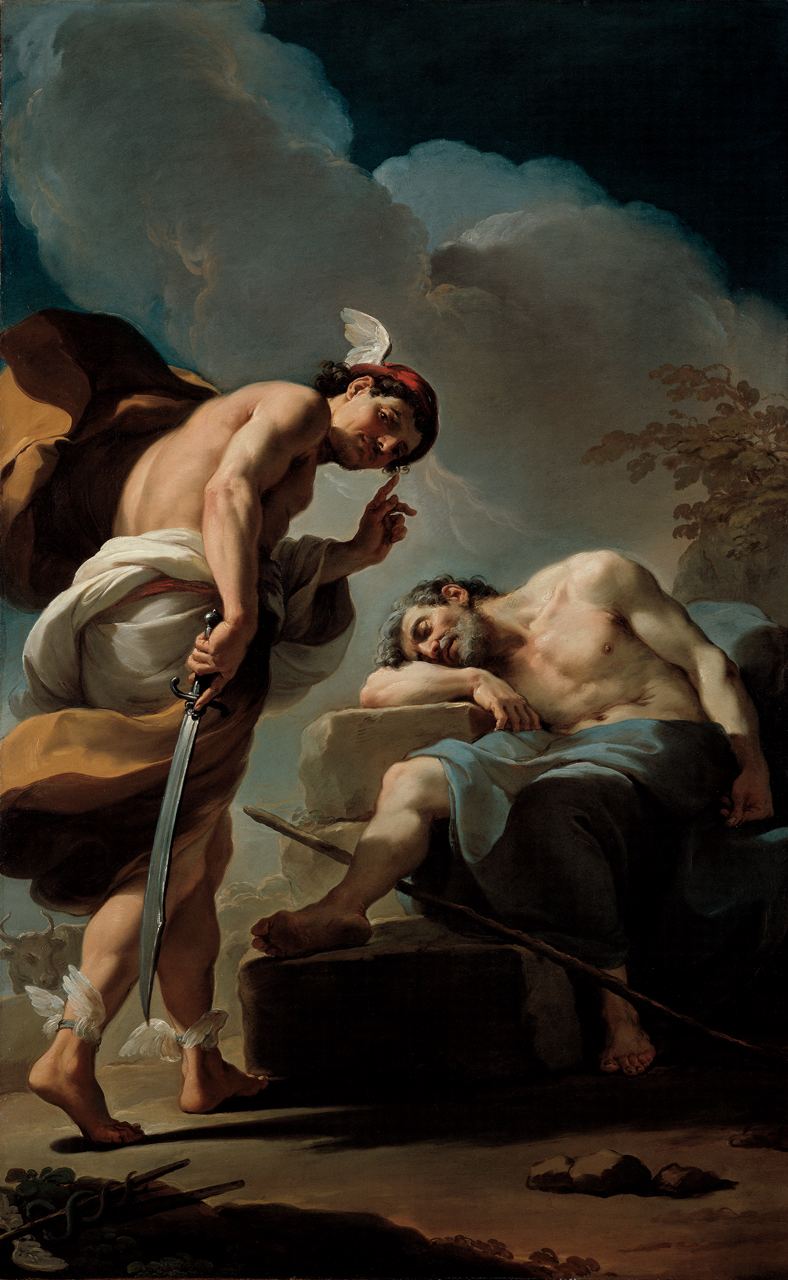
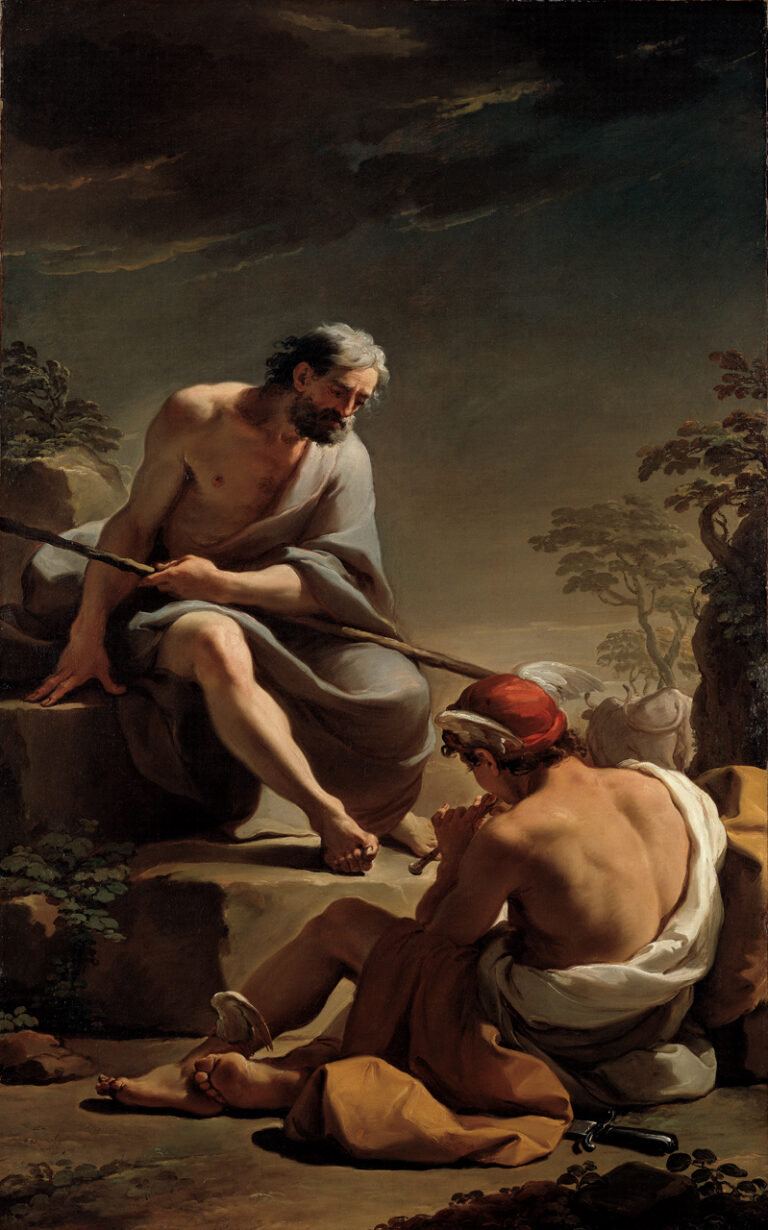
Mercury About to Behead Argus was commissioned by the Marescalchi family for their palace in Bologna, Italy. This painting and Mercury Lulling Argus to Sleep are part of a series of six paintings that illustrate classical Roman myths. The two paintings illustrate consecutive moments in the same story. In Mercury Lulling Argus to Sleep, Mercury, wearing a winged cap and winged ankle bracelets, puts Argus to sleep by playing his flute. In Mercury About to Behead Argus, the artist adds a touch of humor by having Mercury gesture to the viewer to be quiet so they do not wake the sleeping giant.
The Gandolfi family, made up of Ubaldo, his brother Gaetano, and his nephew Mauro, were among the last famous painters of the Bolognese school. The school became internationally famous at the end of the 16th century. The Bolognese school of painting focused on realistic depictions of human anatomy and drawing from live models.
The story depicted in these paintings comes from Roman mythology. Io (eye-oh) was a princess who was seduced by Jupiter, king of the gods. To conceal his infidelity from his wife, Juno, Jupiter changed Io into a white heifer (young female cow). Juno was suspicious of Jupiter and asked for the heifer as a gift, a request that Jupiter could not easily refuse. His wife placed the heifer under the guard of Argus, a giant with 100 eyes (whom Gandolfi chose to depict with only two eyes in this painting). Jupiter sent Mercury to rescue Io from Argus. To make Argus fall asleep, Mercury played music on his flute and then cut off the sleeping giant’s head.
tags: narrative, mythology, communication, identity, power, variation, conflict