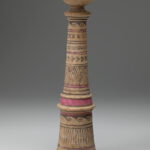
This thymiaterion is made from terra-cotta, which is a fire-resistant material. It was created in ancient Daunia. Daunians were an Iapygian tribe that inhabited Iapygia (modern-day northern Apulia) during classical antiquity. Classical antiquity is a time period that spans from the eighth century BCE to the decline of the Roman Empire in the fifth century. This time period is known for the widespread influence of Greco-Roman culture throughout the Mediterranean.
This incense burner is made up of a cylindrical stand topped with a bowl. The bowl’s interior is painted with a six-petal rosette. Incense would have been burned in the cup at the top of the incense burner. However, this incense burner has no signs of being scorched.
The vessel’s stand is decorated with bands of designs in faded black and pink pigment. This decoration is typical of the final phase of Daunian geometric ceramic production. These ceramics are often called listata ware because of the organization of the design motifs into zones or liste. The stand is divided into uneven thirds by two convex moldings in the center. The lower part of the base is decorated with a frieze of outlined lozenges (diamond shapes) between two bands of wave patterns, each framed by double gloss lines. This band pattern is found on other thymiateria (plural form of thymiaterion).
The upper part of Daunian vessels of this shape usually contain six or seven bands of decoration, one of which can be larger than the rest. On this thymiaterion the patterns include (from bottom to top): a wave pattern, upright triangles (some with added pink in their centers), a garland of lobe-shaped leaves, a line weaving between a row of dots, a chain alternating with tiny flowers, and an upside-down wave pattern.
The function of incense in Daunian daily life is unknown. We know the ancient Greeks and Etruscans used incense burners while performing ritual acts, including sacrifices, funerary rites, and banqueting. Incense was imported from southern Arabia during this time. It would have been expensive to buy. Burning incense has been historically associated with wealth, social status, and piety, especially in ancient cultures.