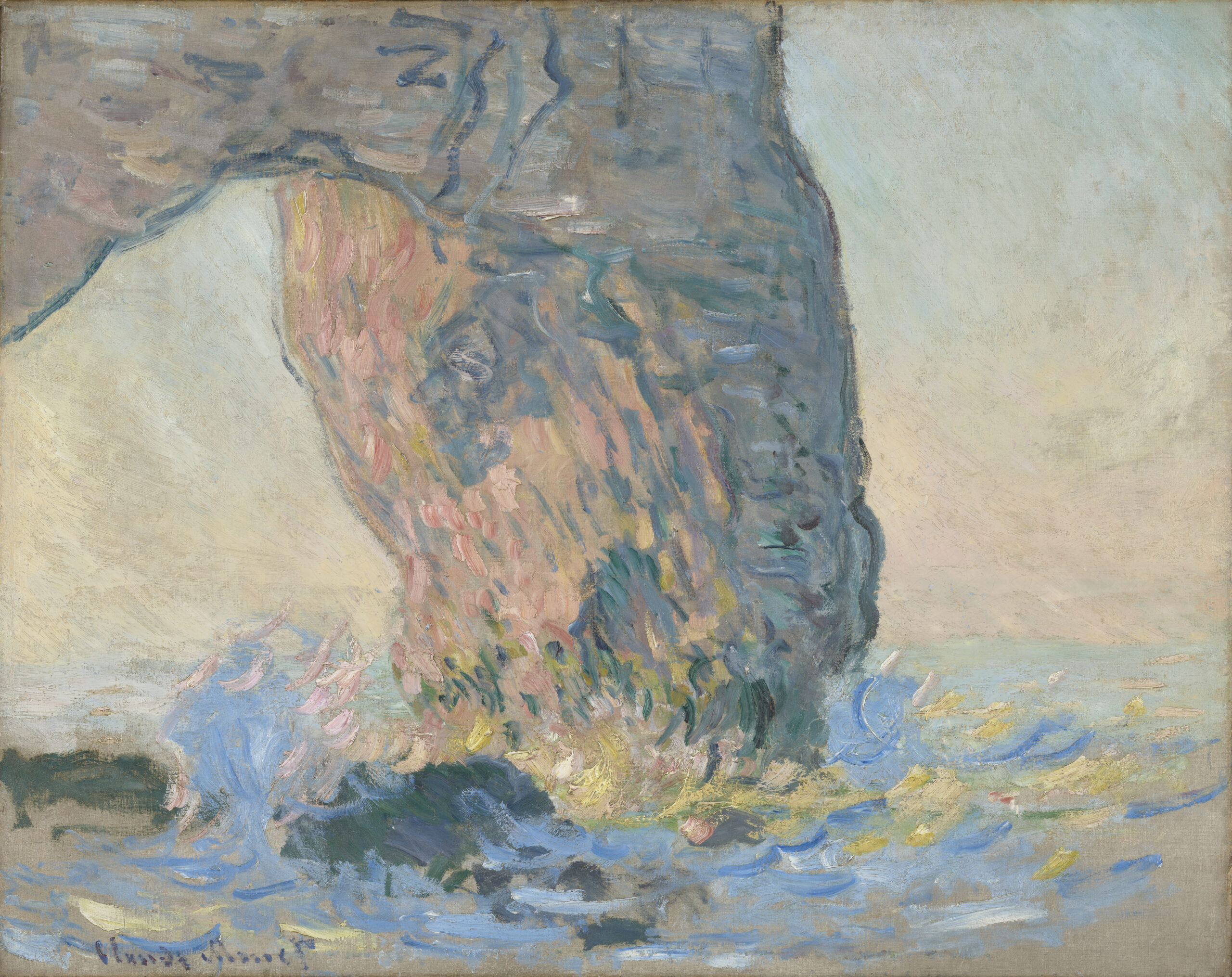
In 1883 Claude Monet spent nearly a month at Étretat, a fishing village and resort on the Normandy coast. He painted many views of the beach and the rock formations in the area. The Manneporte (“Great Portal” in French) is the largest of three limestone arches at Étretat. This natural stone arch was a favorite subject of artists. It would have been challenging for Monet to carry an easel and supplies down to the beach to paint the Manneporte from this perspective. The tide came in fast, so he could only spend a short amount of time in the spot where he created this painting. He had to pay close attention to the incoming waves, to avoid getting hurt or having his equipment destroyed.
The rough, short brushstrokes Monet used to create Waves at the Manneporte show that he created the painting quickly. He had to work fast to capture the way the sun lit the stone arch and reflected in the spray of the breaking waves. This painting was created over the course of at least two separate sessions. Monet added the broad strokes (along the ridges of the stone arch) and the thick, pastel-colored highlights (at the bottom of the arch) after he made the initial, rough-sketch version on the beach. The yellow highlights he added to the water indicate that the sun is setting behind the rocks. He kept the sky and the distant background very simple.
Monet destroyed most of these “quick paintings” because art dealers convinced him that no one would want to buy them. Fortunately he held on to Waves at the Manneporte. His friend, an American painter named John Singer Sargent, visited his studio in 1887. When Sargent saw this painting, he begged Monet to sell it to him.