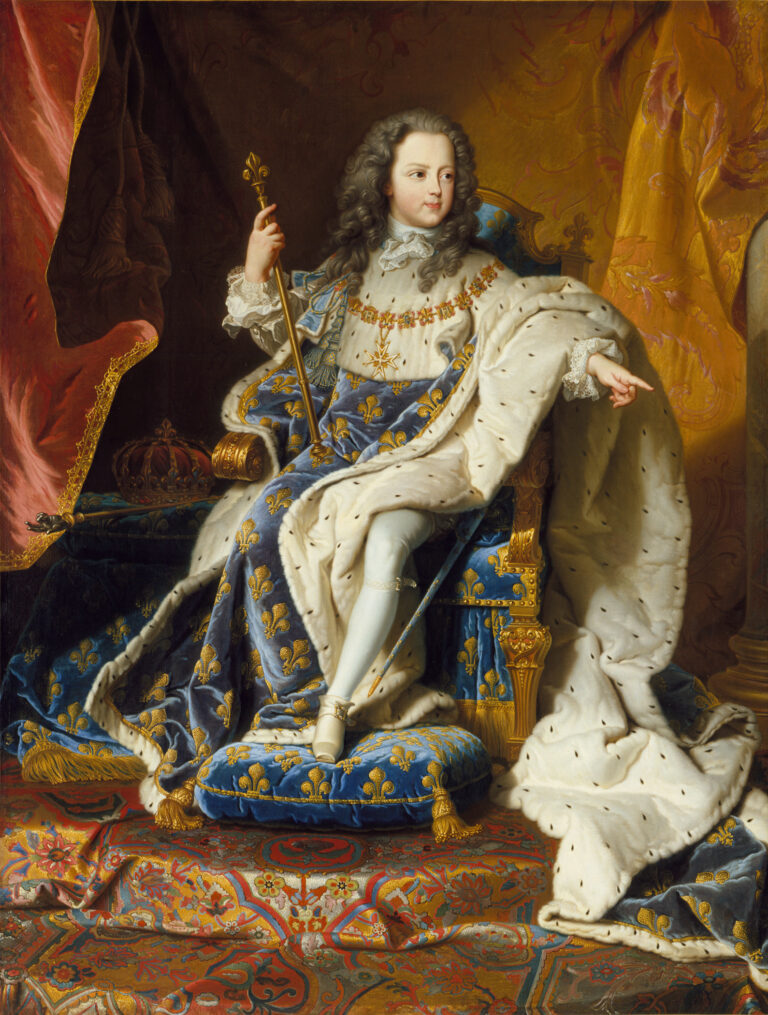
Students will investigate the power of propaganda by studying a portrait of King Louis XV and the situation behind its creation and by creating an example of propaganda that could have been created during the time of Louis XV.
1. Introduce Rigaud’s portrait of Louis XV to students. Begin a discussion about the ways art communicates information visually using the portrait as an example of a persuasive tool and the text for the Art of Communication topic [see About the Art tab]. Discuss:
2. Provide students with the handout on 18th-century France and attitudes toward Louis XIV and Louis XV. Students may attempt additional research, but the handout includes information that may be difficult to find online or in general encyclopedias. Ask students to consider the portrait from the point of view of an 18th-century French person based on the information in the handout. Consider:
3. Inform students that outside of official court portraits, French citizens also saw the king’s portrait on a propaganda pamphlet published by supporters or detractors. Ask students to visualize what the portrait would look like, based on the point of view of the person publishing the pamphlet. How would a noble person make the king look? How would an anti-royalist depict the king? Have students respond in their writing journals.
4. Have students get in small groups of three to four to create a propaganda pamphlet about the new king from one of the following perspectives: natural (illegitimate, but recognized) child of Louis XIV; Philippe, duc d’Orléans; or a French anti-royalist. Before writing, have students bring in examples of modern documents with rhetorical language, such as newspaper editorials, campaign endorsements, advertisements, and real estate pamphlets. In their groups, ask students to determine frequent characteristics that appear in these texts, such as word choice, verb tense, subject (first, second, or third person). As a group, determine:
5. Using the informational handout and language analysis of rhetorical texts, have students write text for a propaganda pamphlet from their chosen point of view as a group. Instruct them to:
6. Once students have written and revised their text, ask them to create a portrait of Louis XV; Louis XIV; or Philippe, duc d’Orléans to accompany their texts. Remind them of the discussion about visualizing a portrait from a specific point of view from Step 3. Have students strategize and complete a design for the pamphlet that uses the text and image effectively.
7. Have the groups reproduce their pamphlets for the class. Discuss the different strategies groups used to communicate their assigned point of view. Have students reflect in their writing journal on the process of creating an argument. Consider: How did your point of view come across in the pamphlet? How persuasive was your argument? What parts of your argument worked well? What could have worked better? What would you change about your argument after seeing the efforts of the other groups? How did your portrait contribute to your argument?
Escrito por Jill Taylor, educadora de la NCMA
Discussion and writing journal entries will assess students’ interpretation and analysis of a work of art, its intended message, and the similar functions of written language.
The pamphlet will demonstrate the students’ ability to:
Vocabulario
propaganda
regent
retrato
rhetoric
Materiales
Enlaces