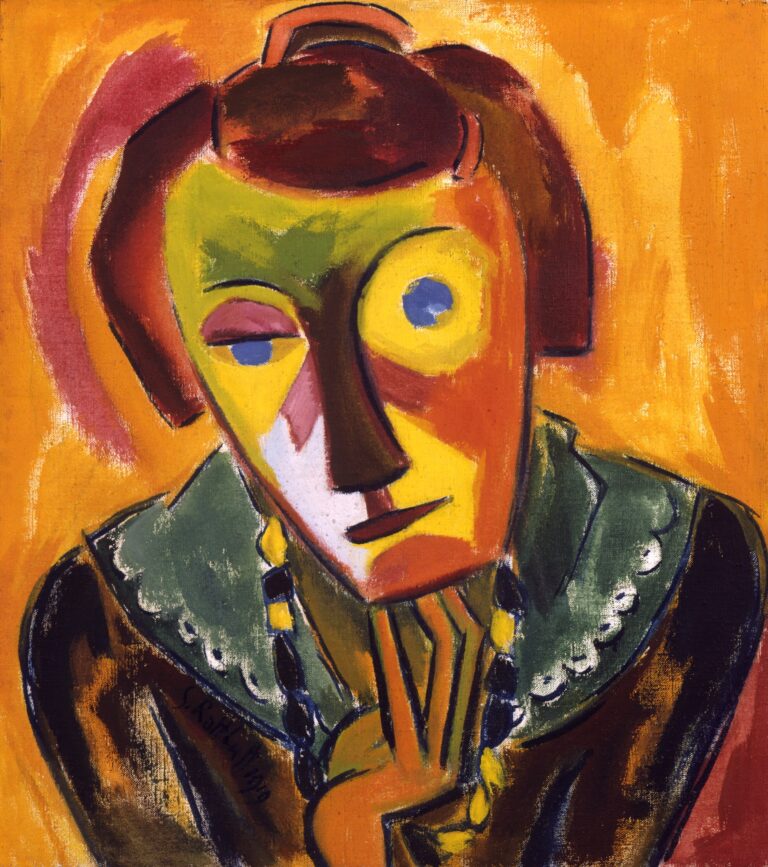
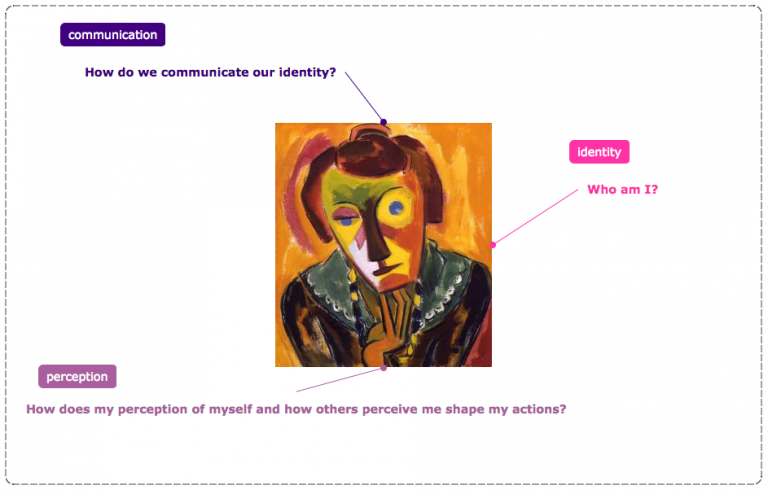
In this two-part assignment, students will consider personal reflection and change as they create a two-sided collaged self-portrait that will be cut and folded into a Boustrophedon book form, also known as ‘snake book form’. Inspired by “Portrait of Emy,” by Karl Schmidt-Rottluff, both portraits (focusing on the recent past and the future) will include text, color, and shape abstraction. After the collages are finished, the book is folded, and cut into a spiral “snake form” effectively merging the artist’s past, current, and future identities into one textured, sculptural form.
● Engage in VTS of Karl Schmidt-Rottluff, Portrait of Emy, 1919, Oil on Canvas
● Discuss the following questions as a class:
○ What do we know about the subject, Emy, based on her portrait? What emotions do you think Emy is expressing?
○ How does Schmidt-Rottluff use color to influence or subvert how we interpret Emy’s character?
○ How has Schmidt-Rottluff abstracted (exaggerated or simplified) the facial features in Emy’s portrait?
● Participate in a writing exercise using the following relevant guiding questions and writing prompts:
○ Based on the discussion regarding observed emotions connecting to the color and expression used in Portrait of Emy, have students identify one emotion that they connect with (optimistic color palette (OPTIMISM), etc).
○ Have students engage in 10-minute reflective writing exercise inspired by their selected emotion.
○ Ask students to partner with a classmate and share their reflections. Ask students to revise and edit their their reflective narrative based on their peer editing.
● View and experience examples of the Boustrophedon form (google boustrophedon book and/or snake book and see template examples here). Explore the history of the Boustrophedon or “ox-turn” form, and look at examples of Ancient Greek boustrophedon inscription.
● Transcribe their revised reflection, based on an emotion illuminated from Portrait of Emy in the ox-turn style, or snake like form. This allows for students to experience their narrative in an alternative and surprising manner. Students will fill the entire sheet with text at varying scales and fonts if they choose. The text will serve as the unifying background for their portrait.
● Select and combine colors and shape that reinforce the overarching narrative and mood in their artwork.
● Create a collaged self-portrait reflecting the changes in the last school year, focusing on color and shape abstraction.
● Using the same process as above on the reverse side of the collage, create an additional portrait focusing on the future (next school year or beyond). Student writing responses should focus on goals, hopes, transitions and change.
● Offer and accept respectful, specific, feedback to and from fellow artists
● After both portraits are complete, fold and cut the Boustrophedon form. Discuss how visual narrative shifts when viewing the work in an alternative point of view
● Exhibit the sculptural books as a class.
Written by Harriet Hoover
● Observation of student dialogue during class discussion of focus art works
● Observe student engagement during art production stage
● Mid-project peer feedback session
● Student self-assessment (using rubric given to student at beginning of lesson)
● Teacher assessment (using rubric given to students at beginning of lesson)
Vocabulary
symbolism, portraiture, abstraction, geometric, organic, collage, Boustrophedon, book arts, chance, reflection, identity, font, scale, perception, sculpture, technolog
Materials
18” x 24” (or smaller) heavy drawing or watercolor paper, color paper and materials for collage, markers, crayons, water activated watercolor crayons, glue stick/glue, scissors.
Links
Websites:
Information on Karl Schmidt-Rottluff, Portrait of Emy
General Information on Boustrophedon writing forms: http://en.wikipedia.org/wiki/Boustrophedon
Information on making the Boustrophedon or “snake book” form: https://pictureengine.net/?p=7903 and
http://makinghandmadebooks.blogspot.com/2011/01/lessons-from-snake-book.html
Symbolism of Color: http://www.incredibleart.org/lessons/middle/color2.htm
Artists who have challenged popular uses and assumptions of color: http://www.moma.org/interactives/exhibitions/2008/colorchart/flashsite/
Contemporary Artists that investigate identity and cross-cultural influences:
● Jiha Moon: https://nmwa.org/explore/artist-profiles/jiha-moon
● Ellen Gallagher: https://art21.org/artist/ellen-gallagher/
● Kerry James Marshall: https://art21.org/artist/kerry-james-marshall/
Books:
Golden, Alisa. Making Handmade Books: 100+ Bindings, Structures & Forms. Lark Crafts, 2011 [ISBN: 1600595871]
Community:
The Scrap Exchange: A creative Reuse Center. 2050 Chapel Hill Rd, Durham, NC 27707. http://scrapexchange.org