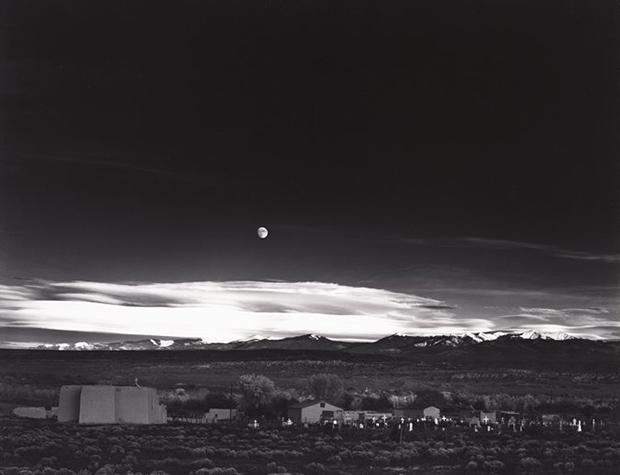
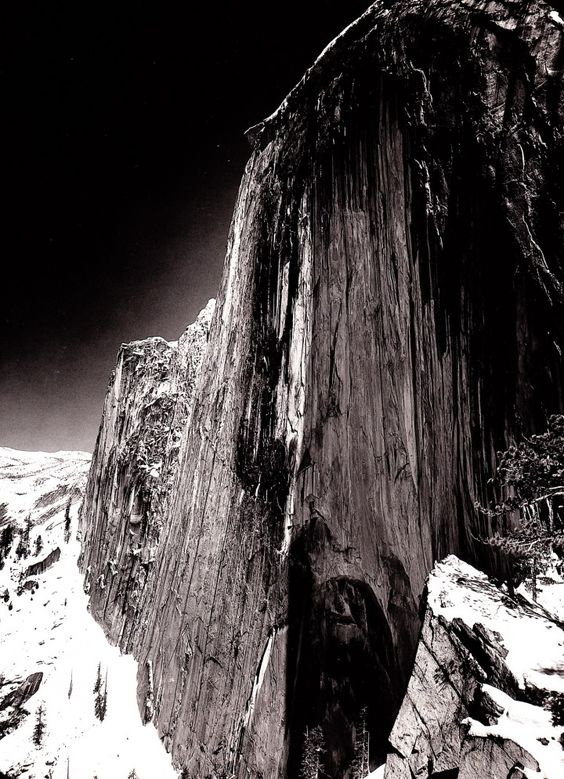
Ansel Adams was born in San Francisco in 1902, and visited California’s spectacular Yosemite Valley for the first time in 1916. Awed by the beauty of the landscape, Adams took his earliest photographs of the park with a Brownie Box camera, returning every summer to photograph. While in his late teens, Adams spent his summers working as a custodian at the Le Conte Memorial, Sierra Club headquarters in Yosemite. In 1927, Parmelian Prints of the High Sierras was published, launching Adams’ career as a professional photographer.
In 1932, Adams had his first major solo exhibition at the M.H. de Young Memorial Museum in San Francisco. Throughout the 1930s, Adams established himself as a leading American photographer, publishing a series of articles and books on photographic techniques, and frequently lecturing about his work. In 1946, he founded the Department of Photography at the California School of Fine Arts in San Francisco, which he followed up with the creation of the seminal photographic magazine, Aperture, a journal that continues to be published today.
Following the major retrospective of his work at the Metropolitan Museum of Art in 1974, Adams spent much of his time re-printing his negatives to satisfy the ever-growing demand for his work from art museums that had, by this point, begun to seriously collect photography as part of their collections.
In 1971, the Sierra Club established the Ansel Adams Award for Conservation Photography, and the Ansel Adams Award for Conservation was created by The Wilderness Society in 1980.