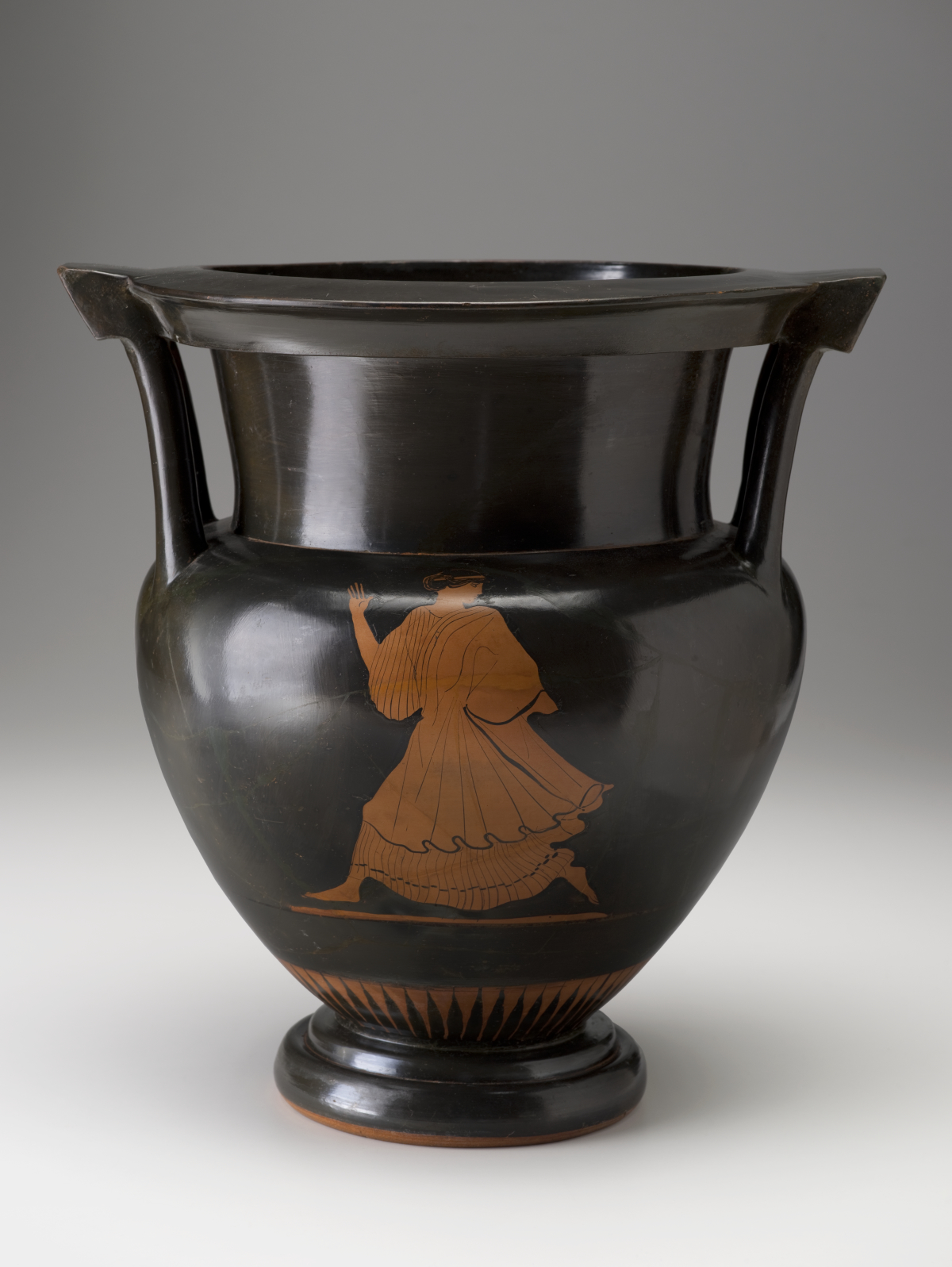
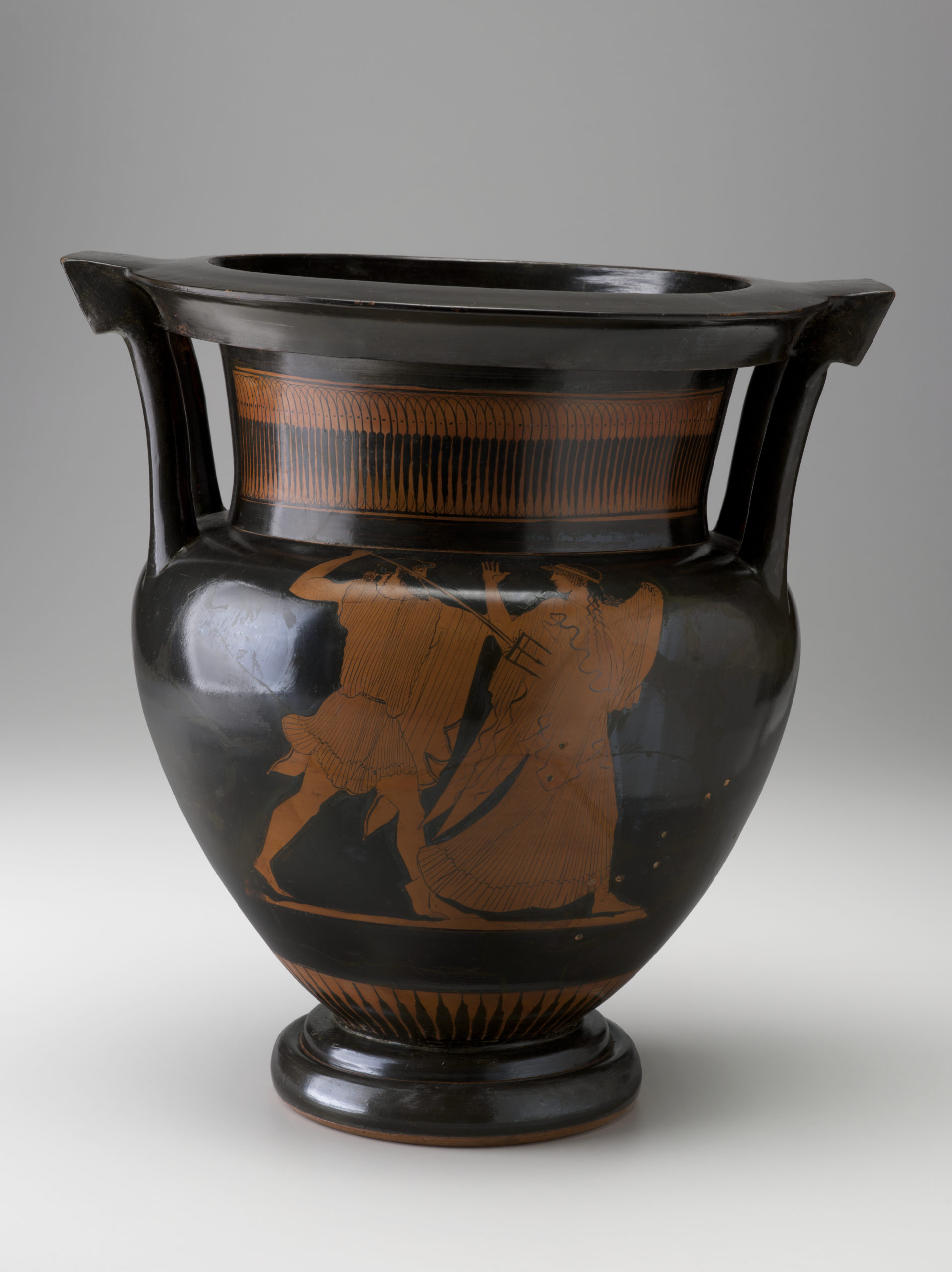
Poseidon, the Greek god of the sea and earthquakes, is often represented in art as a bearded man holding a trident (a three-pronged spear). He is depicted on this vase chasing a young woman with his trident. The woman is running away from him, holding up both of her hands in a gesture of fear or worry. On the other side of the vase, a young woman is shown running away while looking over her shoulder, as if she is also frightened by Poseidon. Scenes like this were common in ancient Greek myths and vase paintings. Ancient Greeks used mythology to explain their society and living conditions. The myths highlighted the experiences (both positive and negative) of real Greek women. These experiences include their domestic lives as well as their social and physical relationships with men.
This vase is a column krater, a type of vessel that was commonly used to mix water and wine for a symposium (a Greek drinking party). The art technique that was used to create the red human figures against a black background is called the red-figure technique. The red color is the natural color of the clay. The black color was created by applying slip, a type of liquid clay, to the background.
tags: ancient Greece, narrative, pattern, function, order, power