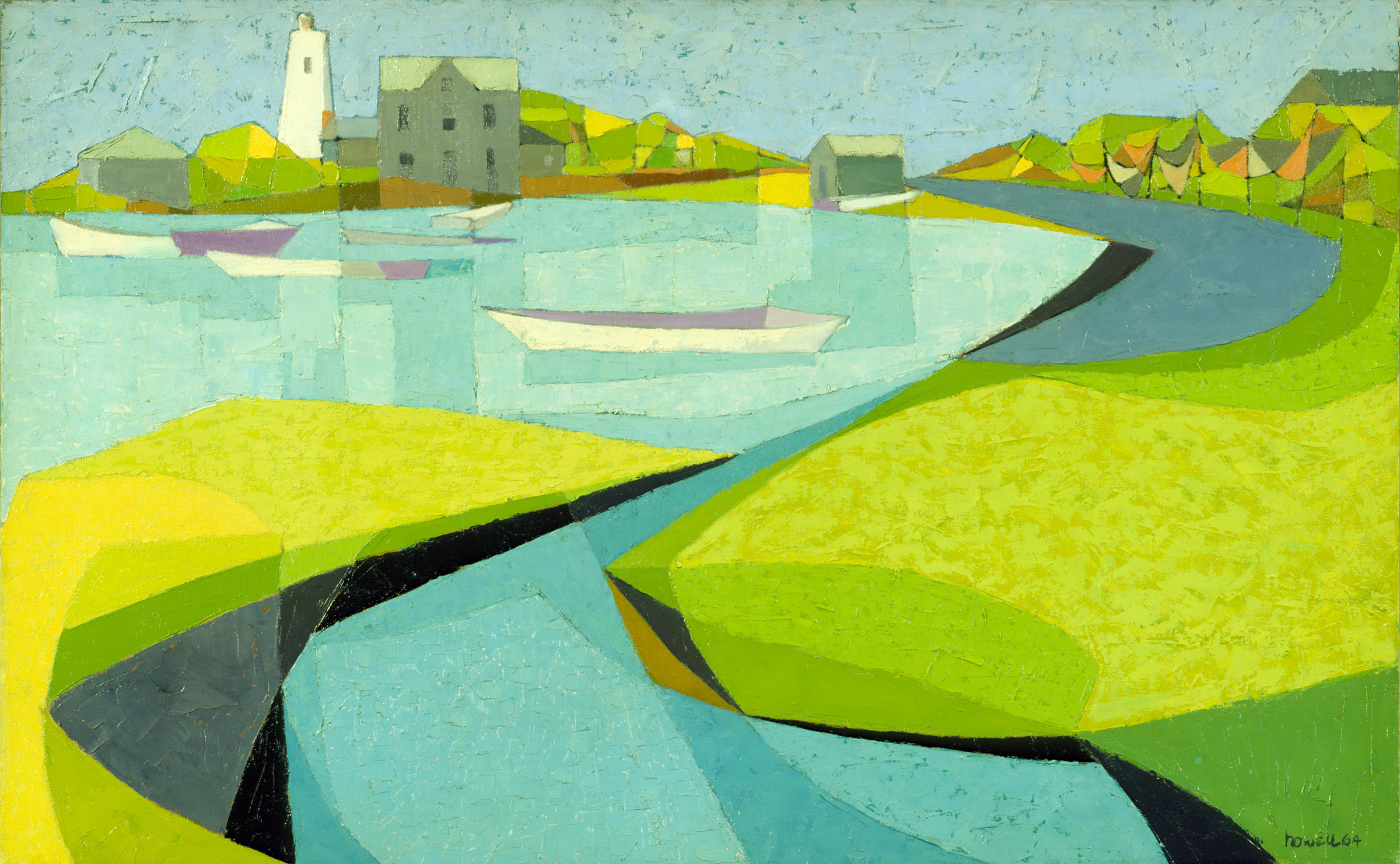
Artist Claude Howell was a native of Wilmington who spent his career painting landscape scenes of the North Carolina coast. He loved the remoteness of Ocracoke Island before, as he put it, “the tourists found it.” The island’s fishermen, sand dunes, and open spaces inspired hundreds of Howell’s sketches. He made his sketches outdoors and took them back to his studio to use as a reference for his paintings.
I am using this subject matter because I know it.
Claude Howell
Howell established the art department at the University of North Carolina at Wilmington in 1953. He chronicled the people and places in his surroundings throughout his career. In 1965, the year after Howell painted Ocracoke Harbor, he suffered a form of poisoning that left him completely paralyzed. He was hospitalized for months and spent two years relearning to draw and paint.
Ocracoke Harbor is a work Howell created using a high key painting technique. He used mostly light values, staying in the upper half of the value scale (midtones to white), with minimal darks to create a bright, airy, uplifting, or joyous feeling. The all-white lighthouse on Ocracoke Island is a recognizable landmark in this painting.
Throughout the 1800s the Ocracoke Lighthouse guided ships into the harbor with goods bound for the mainland. Since then the islanders have survived on fishing and tourism. This lighthouse is the oldest one in the state that is still in use. It continues to serve as a navigational aid for ships. Although it is a functioning lighthouse, the tower itself is not open to visitors.
Long before the lighthouse was constructed, Blackbeard the pirate was killed by the British Navy in the waters off the Ocracoke Harbor. Today the island is accessible only by boat and small aircraft.