In the 1700s French art students competed for a major award called the Grand Prix, which allowed winners to study in Rome. Peyron won the prize in 1773 and spent seven years studying classical art and sculpture. This experience influenced his use of strong outlines, balanced compositions, and historical subjects.
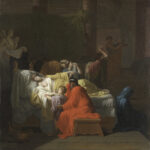
When Peyron returned to Paris, he received an important commission from King Louis XVI. The king asked him to paint a scene showing the death of Alcestis. The first version of this painting was shown in 1785 and is now in the Louvre Museum in Paris. Peyron’s second version of The Death of Alcestis is in the NCMA collection. He created this smaller version of his painting in 1794 and made several changes to it. He adjusted the position of a servant in the center so the figure’s profile looks more like an ancient sculpture. He also simplified the design of the furniture and placed greater attention on the flowing folds of the clothing.
The story of Alcestis comes from a play by Euripides. In the play a queen named Alcestis offers her life after her husband angers the gods. Peyron’s painting shows the moment following her decision, as her husband and child react to her death.
During the time in which this painting was created, artistic tastes in France were shifting. The light and decorative themes of the earlier rococo style were becoming less popular. Artists working in the neoclassical style instead focused on subjects from ancient history and mythology, often highlighting themes such as duty, sacrifice, and loyalty.
tags: mythology, narrative