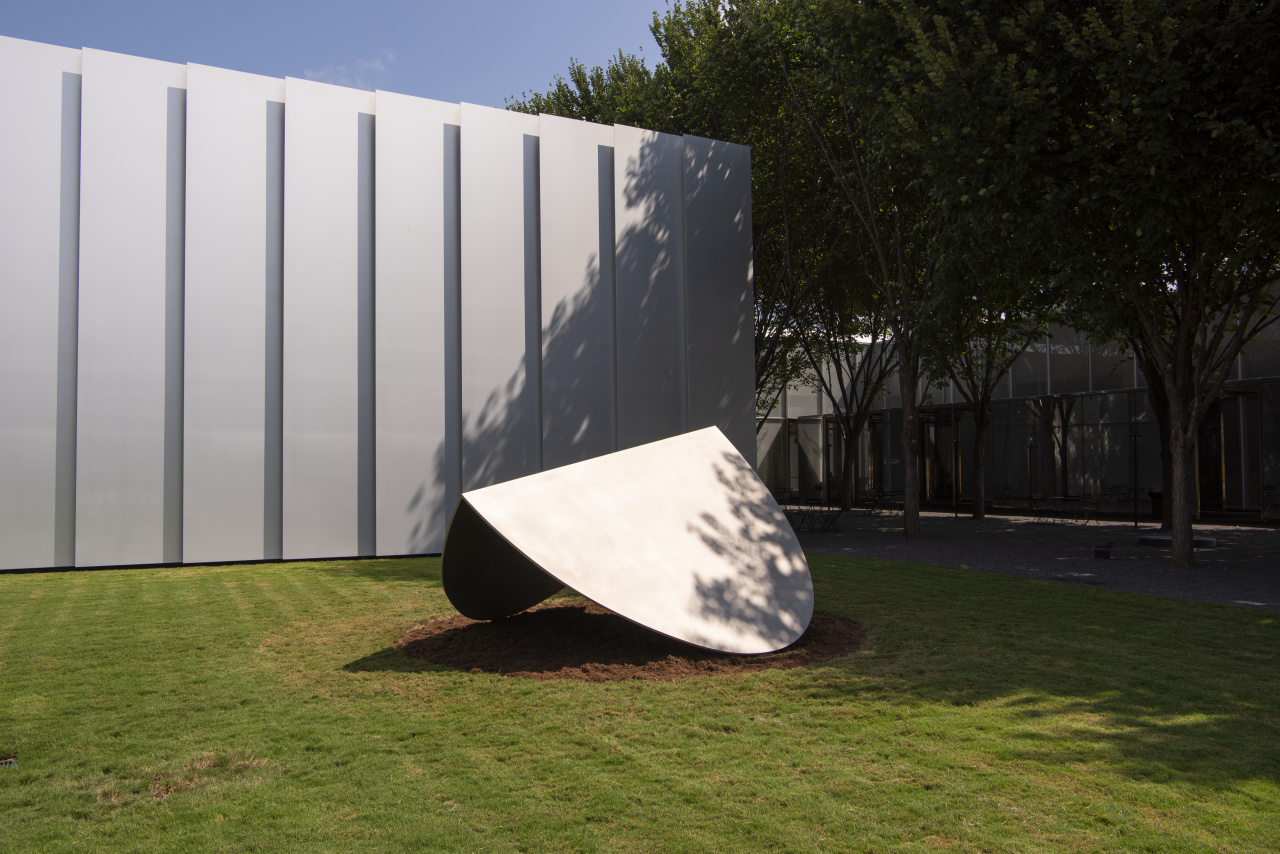
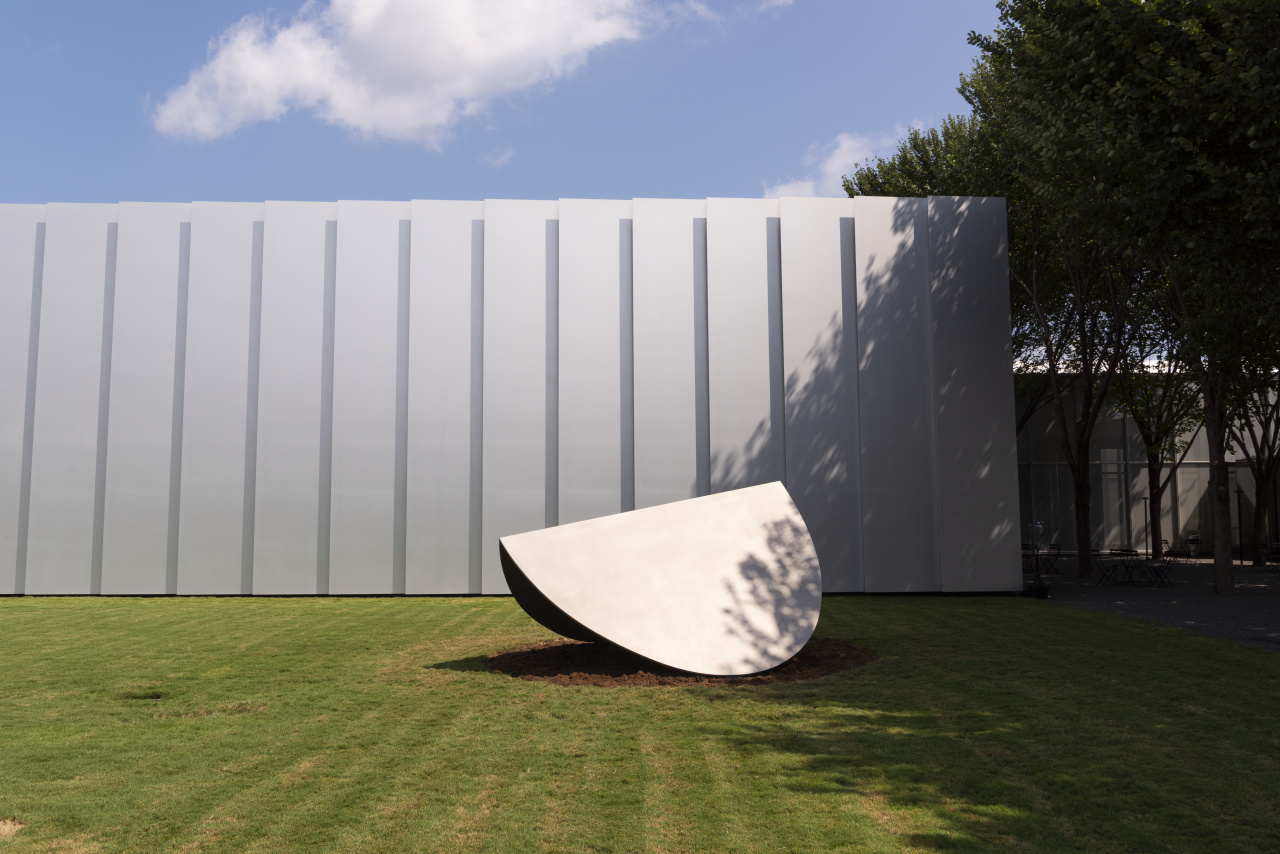
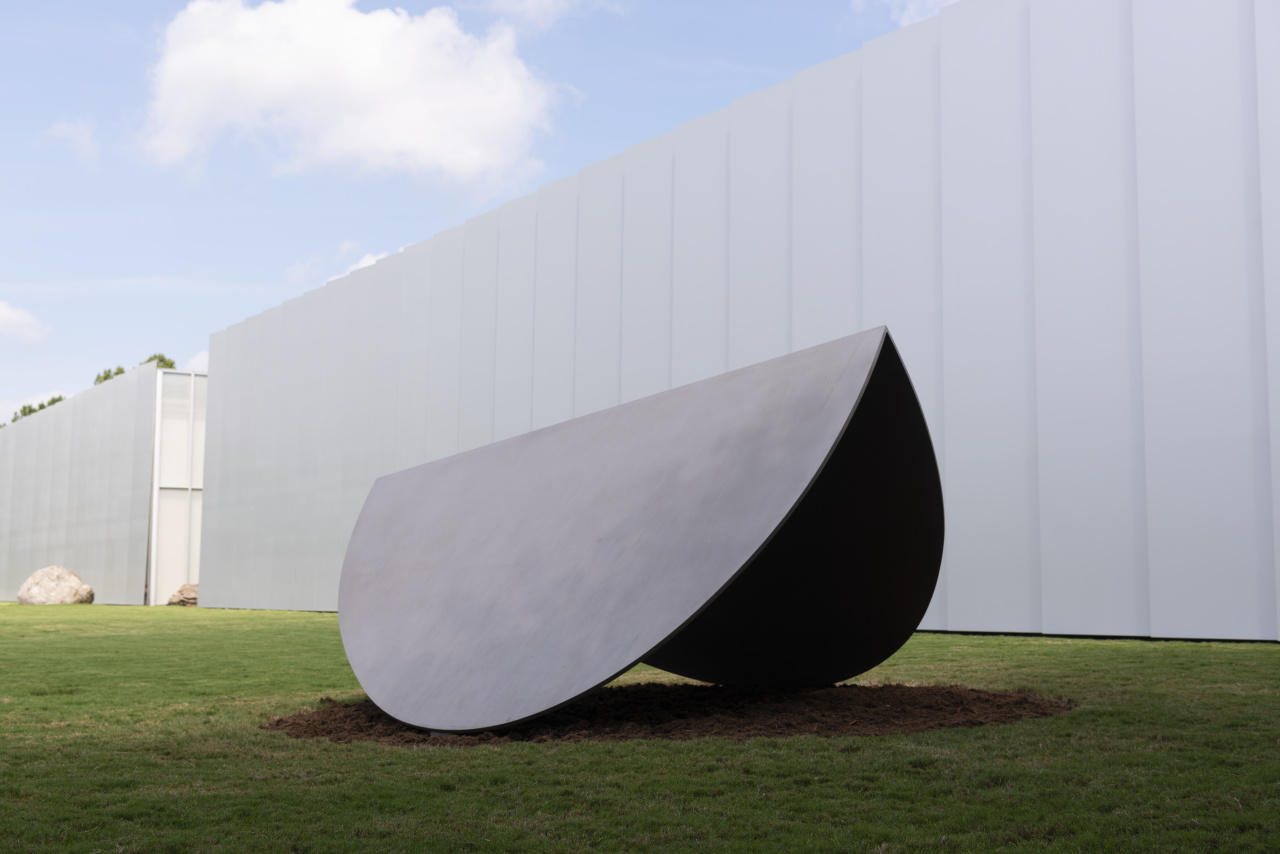
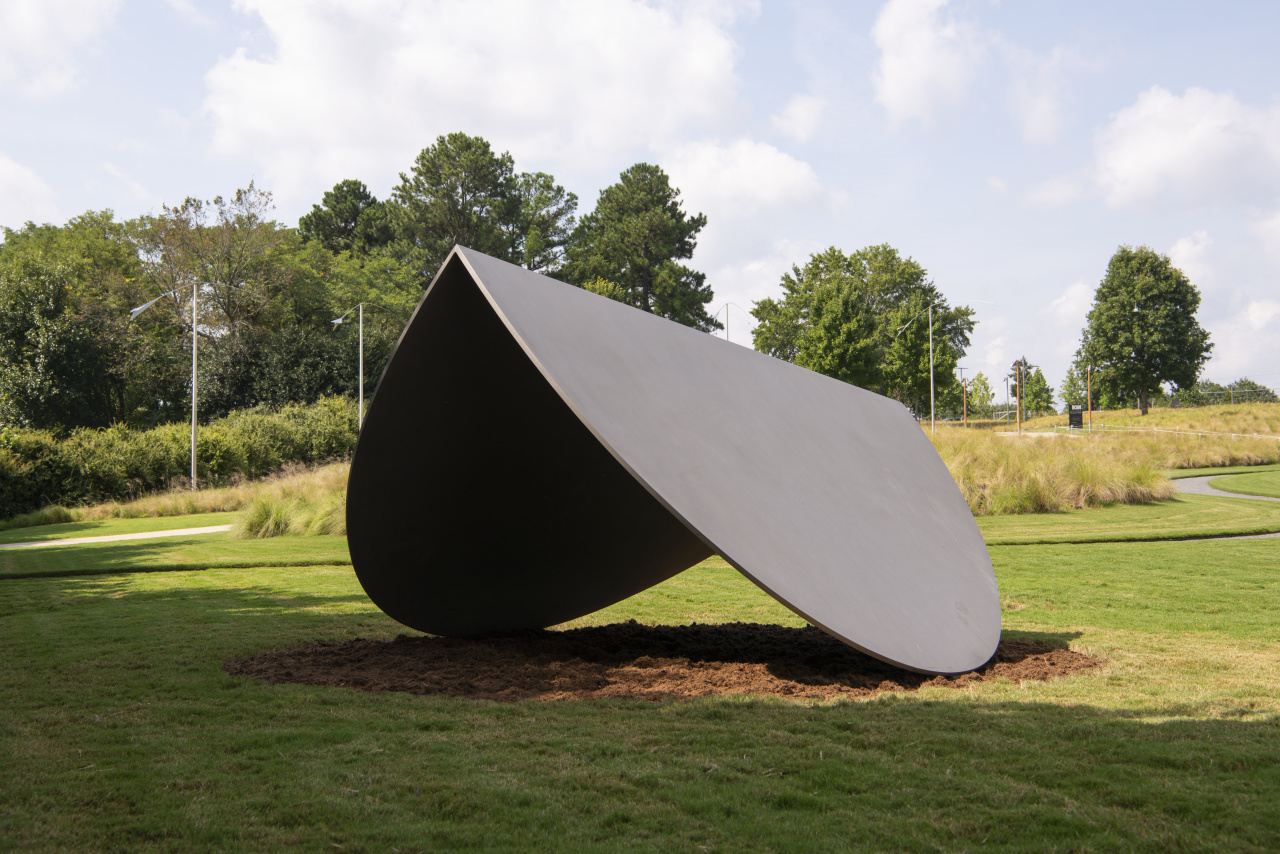
This abstract sculpture is part of Ellsworth Kelly’s Rocker series. The works in this series were inspired by a takeout coffee cup lid. Kelly cut out a flat section of the plastic lid, folded it in half, and rocked it back and forth on a table. This experiment with an everyday object led him to create multiple sculptures that are simple in form (a folded ellipse) and large in scale.
Everything that I saw became something to be made, and it had to be exactly as it was, with nothing added. It was a new freedom: there was no longer the need to compose. The subject was there already made, and I could take from everything.
Ellsworth Kelly
Untitled is made up of two steel planes that are angled toward one another and meet at the top, similar to a pitched roof. Its rounded edges rest on the flat ground under it. Depending on the viewer’s perspective and the sunlight, the sculpture’s form, depth, and dimensional qualities can look very different.
I think that if you can turn off the mind and look only with the eyes, ultimately everything becomes abstract.
Ellsworth Kelly
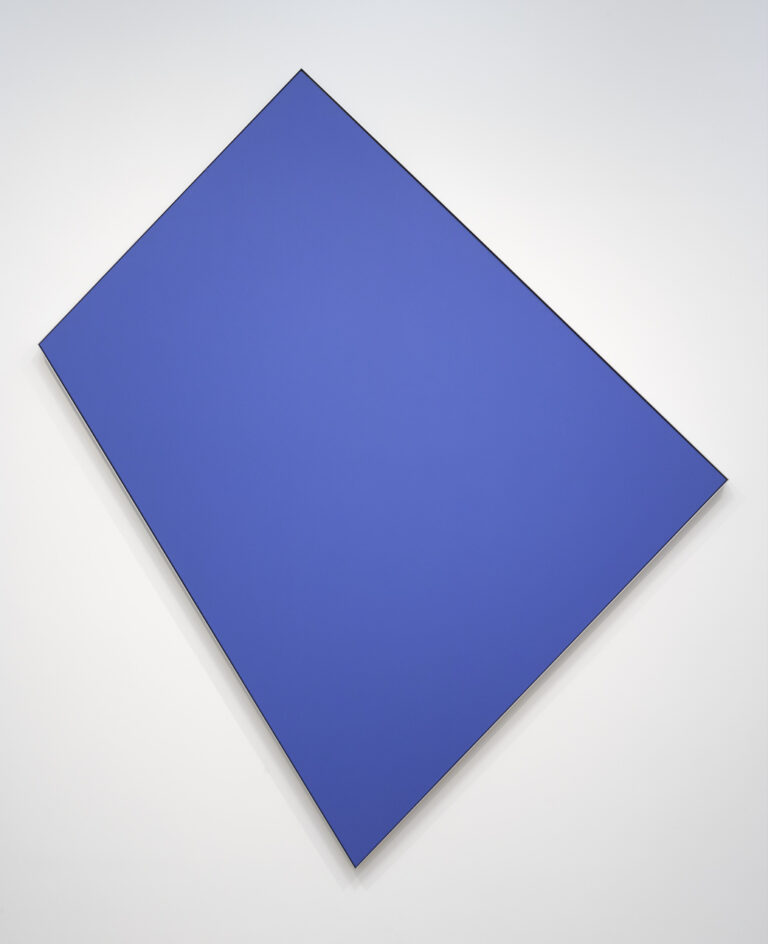
Kelly was an American painter, sculptor, and printmaker. He is considered to be one of the most influential abstract artists of the 20th century. He is best known for his abstract geometric paintings (which he called “panels”) that explore the relationships between shape, color, and form. One of Kelly’s monochromatic abstract paintings, Blue Panel, is included in the NCMA’s permanent collection.
Kelly’s work influenced the development of multiple abstract art movements in the 1950s and 1960s. These include hard-edge painting, color field painting, and minimalism. Hard-edge painting is characterized by large, simplified, usually geometric forms on a flat surface. Color field painting involves the application of a single color to large areas of a work. Minimalism often uses simple geometric shapes like squares and rectangles. In the early 1970s, Kelly began creating large-scale outdoor sculptures like this one.
Because this sculpture weighs several thousand pounds, it was challenging to install. A crane was used to lift it from a flatbed truck and over trees to a space on the lawn in the Museum courtyard. Once the sculpture was positioned correctly, it was lowered into place. The installation of this work of art required collaboration and constant communication between the truck driver, the crane operator, and people on the ground. Untitled is on loan from the Hirshhorn Museum and Sculpture Garden in Washington, DC.