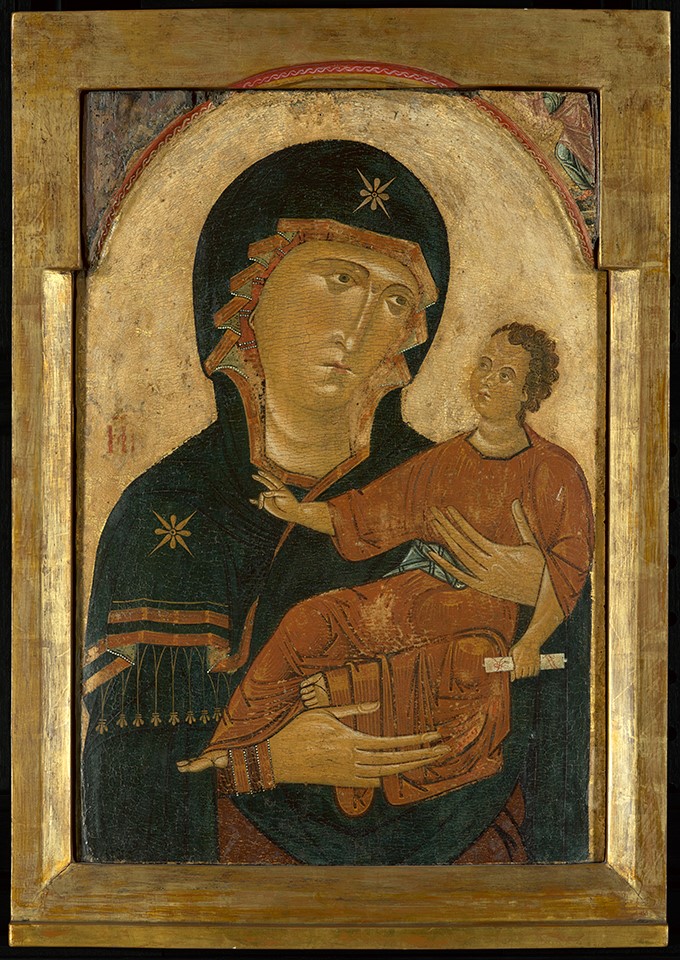
Several members of the Berlinghieri family were active in the Tuscan city of Lucca in the 13th century. Their Italo-Byzantine style of painting was inspired by the religious icons of the Eastern Christian (Byzantine) tradition. This painting style features elongated figures with solemn expressions silhouetted against a gold background. Long, continuous lines define facial features such as the brows and nose, and dark triangles represent shadows under the eyes.
The Virgin Mary’s fringed veil is decorated with stars to show that she is the “Star of the Sea” (the meaning of the Jewish form of her name, Miriam) and as a reminder that she is as constant as the North Star, which represents guidance, hope, and inspiration. She holds the Christ Child high as he extends his right hand in a gesture of blessing. The infant Jesus is depicted holding a scroll of Old Testament scriptures, as a reminder that he is the Messiah foretold by the Jewish prophets.
This painting most likely served as the center panel of a triptych. The two missing outer panels or “wings,” may have depicted saints and/or scenes from the life of Christ. The wings would have closed underneath the spandrels (triangular spaces between the top of an arch and a rectangular frame) in the upper corners of the center panel. One angel is visible in the right spandrel, but its mate on the left side has been damaged beyond recognition.
Tags: medieval, symbolism