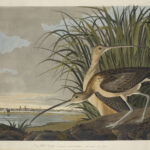
This print depicts a pair of Long-billed Curlews standing in front of tall marsh grasses. In the background there are sailboats in South Carolina’s Charleston Harbor, waterfront buildings, and tall-steepled churches. At left is Fort Sumter, where the first shots of the American Civil War were fired on April 12, 1861.
John James Audubon was an artist who studied birds and the natural world. His combined interests led him to create a series of books titled The Birds of America. The books feature detailed illustrations of North American bird species in their natural habitats. This hand-colored print of the Long-billed Curlew is included in The Birds of America.
While camping on an island in South Carolina, Audubon studied a large flock of Long-billed Curlews. During that time, the birds were plentiful and widely sold as food in markets. The species has declined since Audubon’s time, due to hunting and habitat loss. This now rare bird is the largest shorebird in North America. Its downward-curving bill is almost eight inches long, which helps the bird hunt for worms, crabs, and shellfish in sand and mud. Long-billed Curlews breed in central and western North America and migrate to the Atlantic coast. After nesting in the western plains, they spend the winter on the coast of North and South Carolina.
Audubon spent 20 years working on The Birds of America project. He explored the American wilderness, observing and sketching 435 different birds in their natural habitats. Audubon also drew birds from posed specimens. He developed a technique of wiring recently killed birds into natural-looking poses. In order to depict life-size birds, Audubon used a large-scale book format known as a double elephant folio. The first editions of The Birds of America books measure more than three feet tall and more than two feet wide.
The plate number in the title (#231) refers to the number etched into the copper engraving plate that was used to create the print. The original copper plates were used to produce black and white images. Audubon colored the images by hand to create the final prints. Each plate was numbered and corresponded to a specific bird.
tags: medio ambiente, naturalismo, animales, ecosistema, agua, investigación, observación, lugar