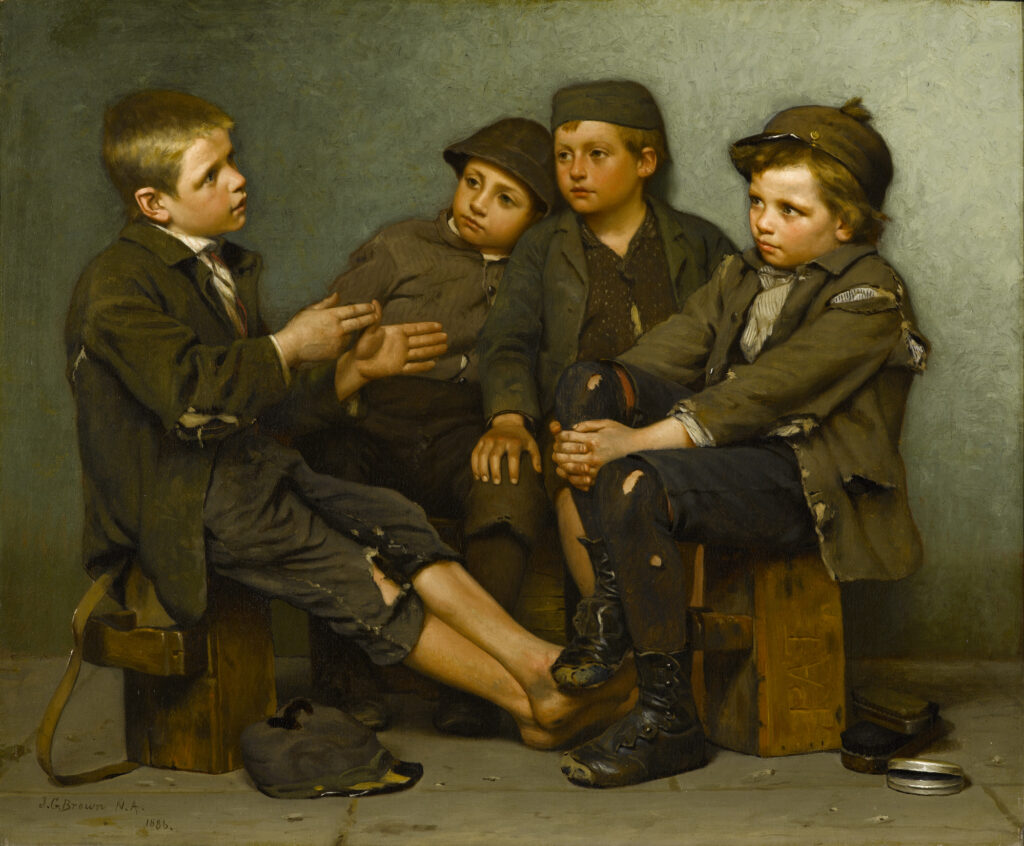


Students will learn about child labor and attitudes toward children in the 19th century through one painting and multiple photographs. In discussion and writing, they will also consider the differences between photography and painting as mediums for expressing these attitudes.
1. Hold a brief class discussion focused on student perceptions of how Americans may have viewed labor, and child labor specifically, in the 1880s.
2. Assign the students to examine and analyze John George Brown’s painting A Tough Story.
3. Continue the class discussion by asking the following questions:
4. Assign the students to examine and analyze Lewis Hine’s photographs.
5. Have the students read some information on Hine and the captions that accompanied some of Hine’s photographs.
6. Continue the class discussion focused on the following questions:
7. Assign the students to read a textbook description of child labor during the Progressive Era. Assign the students to write a one-page paper answering the following question: Which artist (Lewis Hine or John George Brown) do you think most effectively used art to change viewers’ attitudes about child labor? What elements of their works communicated these views?
Written by Zoe Voigt, Humanities Teacher
• The teacher will use class discussion and the paper to determine each student’s understanding of how Lewis Hine and John George Brown helped influence Americans’ response to child labor.
• Class discussion and the paper will be used to assess each student’s analysis of images of child laborers and his or her interpretation of the intentions of those who made the images.
Vocabulary
Progressive Era
Materials
Dijkstra, Bram. American Expressionism: Art and Social Change 1920–1950. New York: Harry N. Abrams, 2003.
Konzett, Delia Caparoso. Ethnic Modernisms: Anzi Yezierska, Zora Neale Hurston, Jean Rhys, and the Aesthetics of Dislocation. New York: Palgrave-Macmillan, 2002.
Pozzetta, George E. Nativism, Discrimination, and Images of Immigrants. New York: Taylor and Francis, 1991.
Links
Photographs by Lewis Hine:


