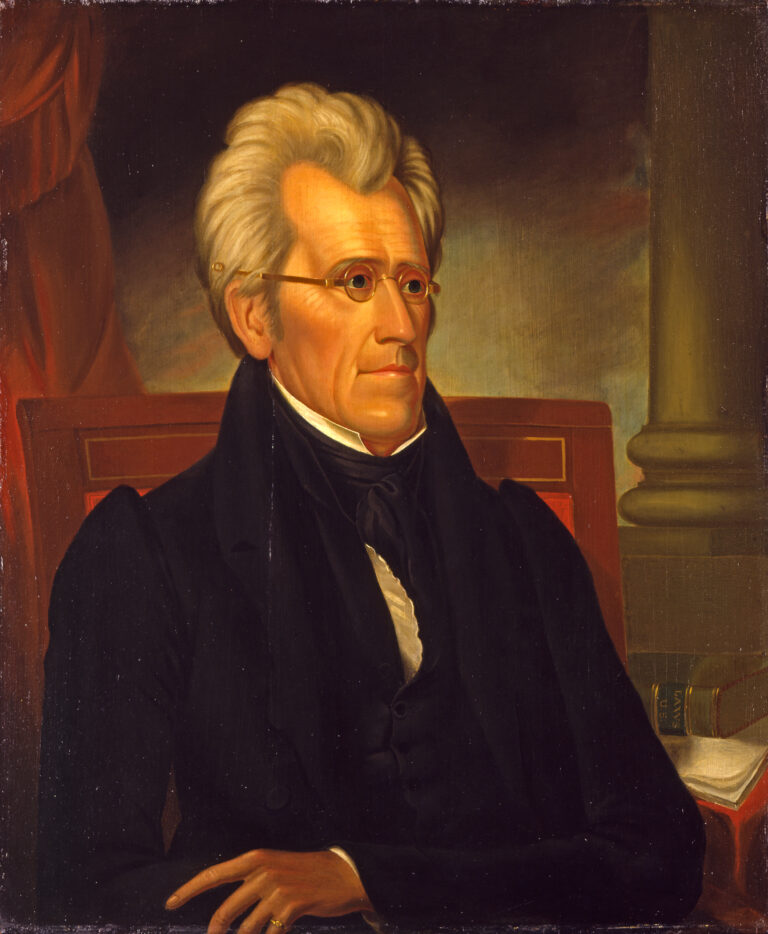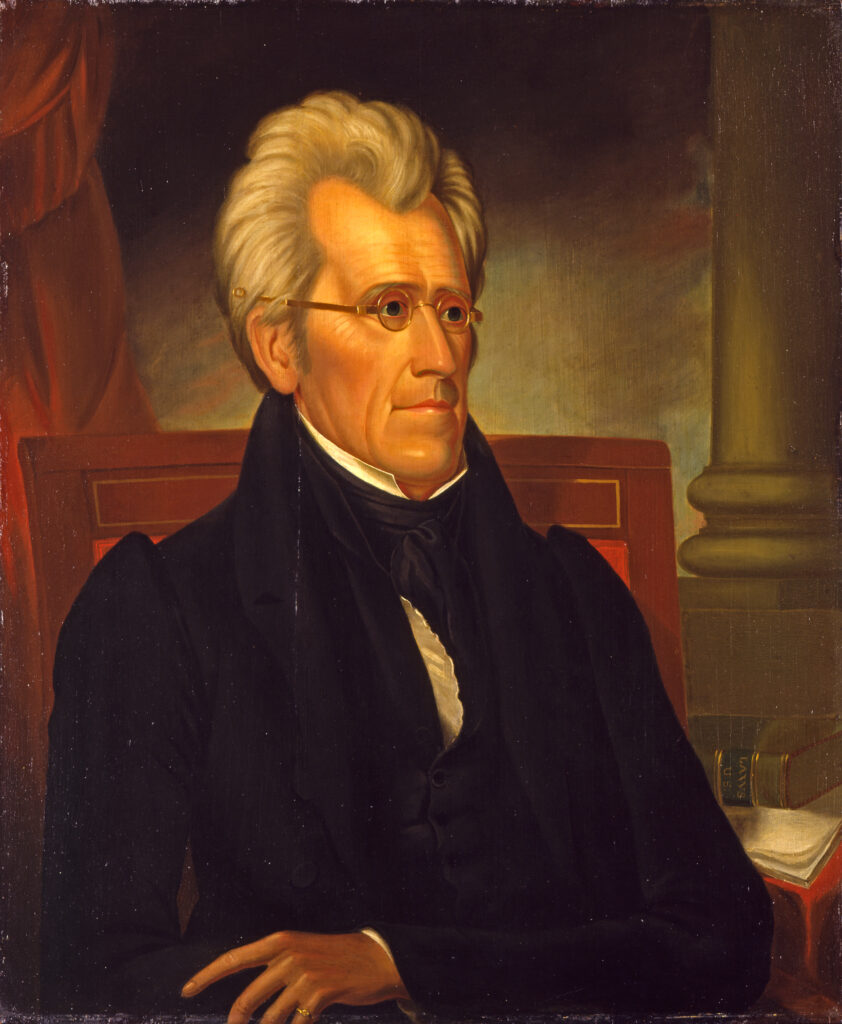


Students will examine the role of perception in interpretation of primary sources in Ralph Earl’s portrait of Andrew Jackson. In small groups, students will research periods in Jackson’s life and use gathered information to create their own portraits of Jackson that communicate facts about actual events filtered through the point of view of someone affected by Jackson.
1. Show students Ralph E. W. Earl’s portrait of Andrew Jackson. Discuss the role of primary sources of written and visual forms in understanding history. Have students describe Jackson’s personality characteristics based on evidence found in the portrait. Solicit questions raised by the portrait, and consider the following.
2. Break the class into smaller groups to research the following periods in the life of Andrew Jackson and to evaluate how these periods reflect events and issues in North Carolina history. Consider how different people might have perceived Andrew Jackson.
3. Keeping students in their small groups, have them collaborate on a portrait of Andrew Jackson that reflects their assigned time. Ask them to select an artistic persona for their depiction that highlights a specific point of view, or perception, of Jackson. For example, their artistic point of view could be that of a soldier who served under Jackson in the War of 1812 or that of a Cherokee Indian affected by the Indian Removal Act. In addition, have students consider Jackson’s age, his clothing, and his environment to depict Jackson accurately at this period. Groups should include significant objects that symbolize events or issues in Jackson’s life. Portraits can be drawn or created using computer programs such as Adobe Photoshop. Groups should complete the Andrew Jackson Portrait Worksheet as a written complement to their portrait.
4. Bring students back together as a class. Have groups show their portraits of Andrew Jackson to the class without giving preliminary explanation. The rest of the class will look for visual clues in the portrait to interpret the work and will pose questions to the group. Guide the discussion by providing conversation subjects and questions covering the style of the depiction, artist point of view, and portrait details (such as those used in Step 1). Give students the Andrew Jackson Portrait Worksheet to use as a guide for discussion. The presenting group will confirm or deny interpretation through the answers they give to questions.
5. Display the portraits in chronological order to create a class timeline of Andrew Jackson’s life. Use the portraits as a basis for discussing his life as a whole and how he affected North Carolina and United States history. Students may compare their portraits of Jackson to others created during his lifetime to further explore the role of perception in understanding primary and secondary sources.
Written by Jill Taylor, NCMA Educator
Vocabulary
portraitidentityprimary source
Materials
art supplies (paper, marker, etc.) or computer imaging program
Andrew Jackson Portrait Worksheet (available for download below)
Links