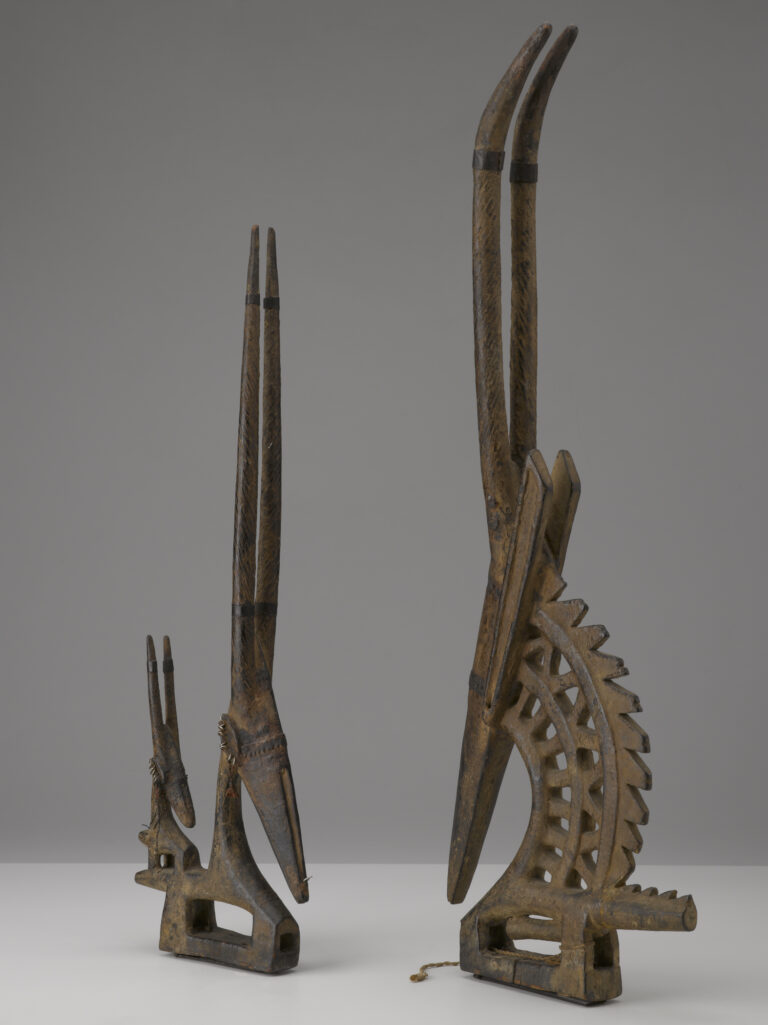
In this multi-day lesson, students will study the function and use of Tji Wara crest masks of the Bamana people of Africa. Using the masks as an example, students will develop a cultural study of their personal talents to create their own crest masks. Students will then choreograph a dance to go with their mask.
1. Warm-up:
Show pictures and discuss mythical beasts that the students might already know such as: centaur, unicorn, griffin, manticore, pegasus and sphinx. Talk about the culture and time period when these beasts were created, and why the culture might “need” to believe in them.
2. Examine the headdresses using critical thinking skills.
Ask students to look closely at the crest masks of the Tji Wara of the Bamana people of Africa.
Lead the students through the following questions, having them respond verbally, through journaling, or both.
3. Bring headdresses into context.
Visit Crest Masks (ciwaraw kun) on NCMALearn and share the information listed about the works of art.
Have the students look again at the photo of the masks with this information in mind.
Ask:
Go to the following link and share with your students these historical photos of similar masks used in context.
Show your students the following video of Bamana Crest Masks in action. (You might want to cue it up to the 5 minute, 30 second mark, as that part of the ceremony gets much more active and includes the women of the village.)
Remind your students that in practice the masks are worn by those farmers of the village deemed the best in the area. It is an honor to wear the Tji Wara masks and participate in the ceremony.
4. Have students consider what they do well.
Stress to students the fact that to the Bamana people being a good farmer is very important for the survival not only of the individual, but also to the community.
Ask students:
Have students answer by journaling, drawing pictures, partner sharing or answering verbally.
5. Students consider and create a mythical being that could help them do what they do well.
Remind students that the Bamana people chose to make their headdresses in the image of a mythical creature, a combination antelope/aardvark. They made this choice because both animals dig in the ground (like farmers) and also because it is their belief that this animal taught their people how to farm.
Ask students to consider animals that might help them do what they do well.
Have students write down animals and the qualities the animals have that might help them do what they do well.
6. Students create their own crest mask/headdress out of cardboard.
Re-examine the image of the NCMA crest masks. Look again at how the crest masks show both the animal and the qualities of the animal (e.g. the zig-zag patterns show how antelope move).
Tell students: You will be creating a crest mask representing the mythical animal/creature that can help you do what you do well. You will be creating it to wear.
7. Students choose movements for their mythical being and using those movements choreograph their own dance to represent their mask.
Have students:
Have students, as a group, create a rhythm/beat with their hands or on drums/percussion instruments. While one group wears their masks and dances their choreographed movement sequence, another group provides the rhythm for the dance. Videotape the students dancing their Dance of What We Do Well.
8. Closing
Share with the students the video of their work. Compare/contrast it with the video of the Bamana people doing their dance.
Written by A+ Fellow Jef Lambdin
This is a multi-day lesson that should be scaffolded according to the abilities of your students.
Teacher may want to spend time on animal idioms when working through animal characteristics that would be helpful for the students.
Supplies needed:
Smartboard/projector & computer
Writing paper or journal for each student
Plain white paper on which to sketch the mask idea for each student
11” x 17” pieces of cardboard – 1 per student (extras for mistakes)
2”- 3” Strips of cloth, approximately 30 inches long – 1 per student
Mat knives and hot glue guns (and glue)
Drums/Percussion instruments
Camera for videotaping