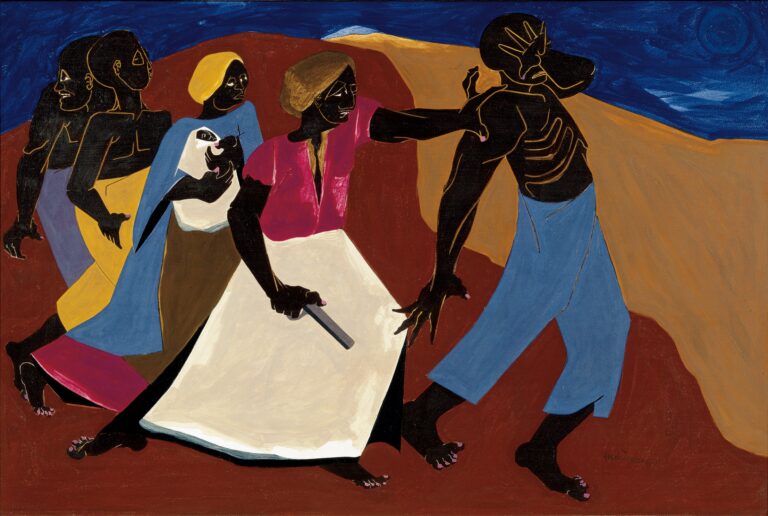
In this lesson, students will explore the ways writing and painting express meaning. They will investigate a biography and painting of Harriet Tubman and consider the tools the artist and writer used to communicate information about this heroine.
1. Choose one of the biographies of Harriet Tubman listed under the Resources tab. Read the story of Harriet Tubman to the students and discuss her life. Ask: When did she live? What do you think life was like at that time for an African American woman? What kind of citizen was she? How did she help her community? Why do you think she did these heroic things? What are her values and principles?
2. Present the black-and-white outline of Jacob Lawrence’s Forward. Tell students that the painting represents the story of Harriet Tubman. Give them each a copy of the outline and allow them to fill in the empty spaces with colors of their choice. Do not show them the color version of the painting beforehand.
3. Compare the students’ work to the original painting. Ask: How are the colors you chose different from or similar to the ones Jacob Lawrence chose? How does the artist’s choice of color affect our reaction to this painting? Why? How do the colors the artist chooses help us determine which figures are most important to the story?
4. Discuss the way color sets a dramatic mood, communicates the time of day, and attracts our attention to the main character in this painting.
5. Review the definition of an adjective and adverb. Give each student the story worksheet. Tell them to fill the blanks with the adjective or adverb of their choice. (Model the activity for the students, if necessary.) Read the completed stories aloud and discuss the differences and similarities among the students’ choices. Ask: How are the words you chose different or similar from the ones your classmates chose? How does word choice affect our reaction to the story?
6. As a group, discuss the similarities in the ways artists and writers use description in their creative works. Ask: What does a writer use to describe or emphasize action or certain character traits in a written text? How does an artist do the same with paint?
7. Have students write an imagined narrative about the event depicted in Forward. Model introducing a narrator, and encourage students to use dialogue and description to convey the emotion of the event. Discuss word choice and relate to the adjective/adverb activity. Confer with students as they write.
Written by Carolyn Walker, English Language Arts Teacher
● Teacher will assess discussion for understanding of the relationship between other subjects and art, use of color as an element of art, and inference of meaning from the focus work.
● Using local rubrics, teacher will assess narrative writing piece, particularly noticing powerful word choice.
● Teacher will evaluate discussion using local rubrics for student participation, including following rules for discussion, building upon others’ ideas, and asking questions.
● Teacher will evaluate writing and discussion for understanding of the influence of Harriet Tubman and her values and principles.
Vocabulary
adjective
adverb
biography
mood
shade
slavery
Underground Railroad
Materials
Markers, colored pencils, or crayons
Biographies of Harriet Tubman:
Links