Aaron Douglas was a central figure of the Harlem Renaissance. This art movement was a “golden age” in African American culture. The Harlem Renaissance began in the Harlem neighborhood of New York City in the 1910s and continued into the mid-1930s. It encouraged the creation of literature, music, stage performances, and art that celebrated Black culture. Aaron Douglas developed an art style that powerfully portrayed Black history, life, and culture. He depicted Black individuals as being in control of their own freedom. His work combines African motifs with modern and art deco art styles.
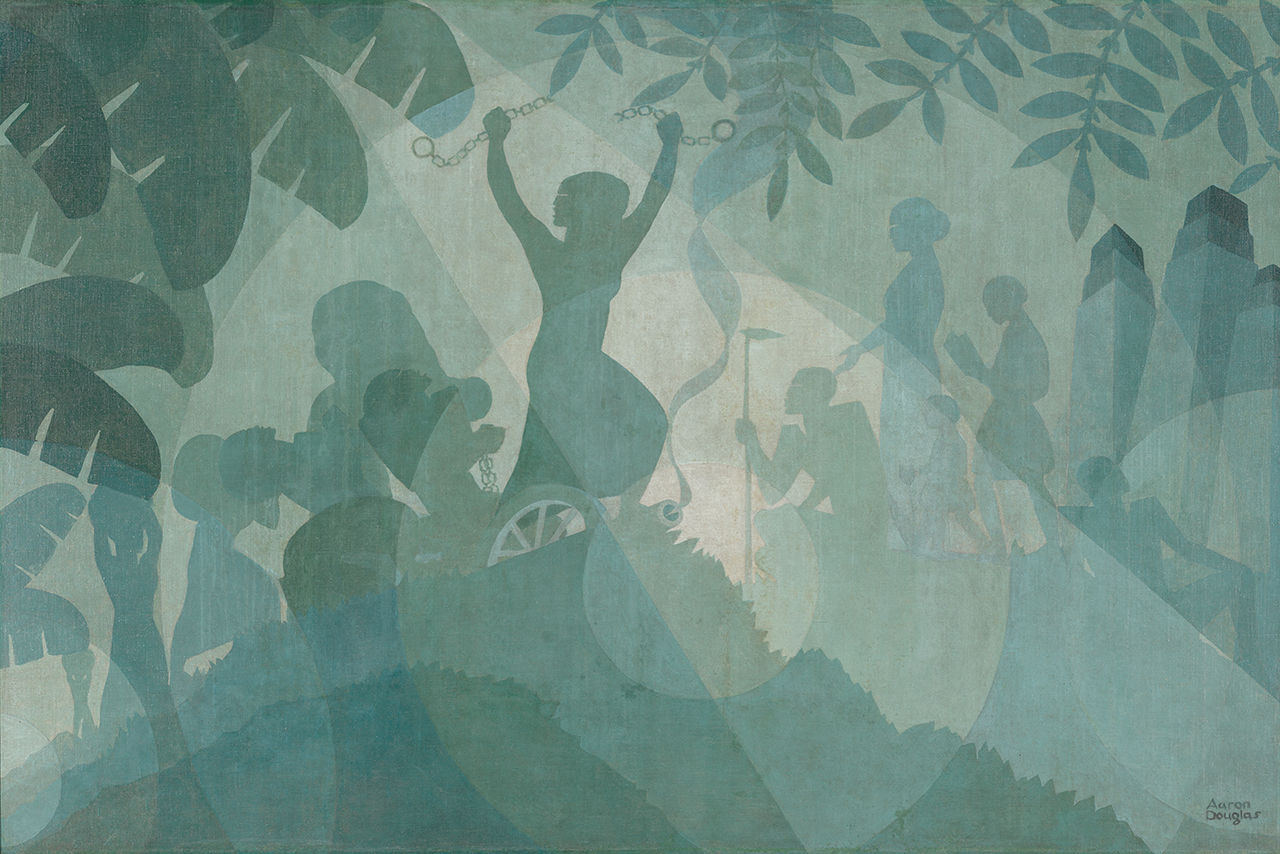
This painting honors the activist legacy of Harriet Tubman. In 1849 Tubman escaped enslavement in Maryland using the Underground Railroad. She returned to lead other enslaved people to freedom. According to her records, she rescued approximately 70 people during roughly 13 trips. She was an abolitionist, Civil War spy, and supporter of women’s suffrage. In 1896 she established the Harriet Tubman Home for the Aged on land near her home. Tubman died in 1913. She was buried with military honors at Fort Hill Cemetery in Auburn, New York.
Douglas layered abstract and geometric shapes (in different shades of similar colors) to create the illusion of light in this painting. One man is depicted holding a hoe, symbolizing the freedom to farm independently. A young woman is reading a book, representing the freedom to gain education. A third man is enjoying his leisure time and gazing at a towering city. Tubman is depicted leading people forward. Douglas wrote that he portrayed Tubman as “a heroic leader breaking the shackles of bondage and pressing on toward a new day.”
Harriet Tubman was commissioned for Bennett College for Women in Greensboro, North Carolina. Bennett College is a historically Black liberal arts college for women.