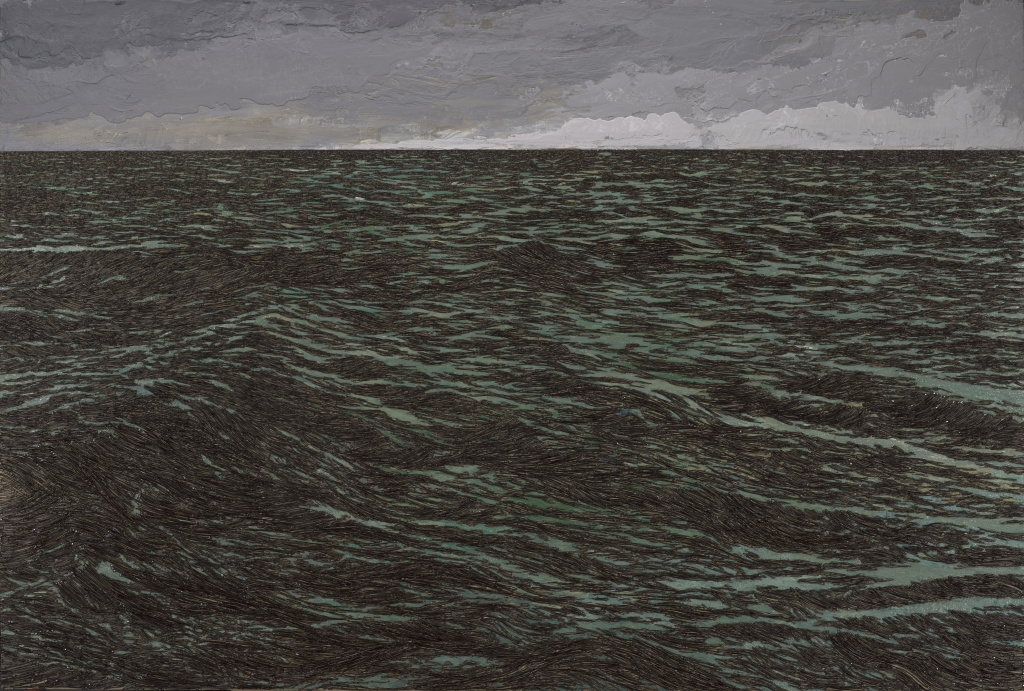
Translated Island (Promised Land), this painting is part of an ongoing series of seascapes by Capote. In this work of art, he uses thousands of fish hooks layered on the canvas to provide value, texture, and movement to the ocean waves. The fish hooks also symbolize how the sea causes feelings of isolation for many Cubans. Capote often relates the ocean to the Iron Curtain of World War II. Much like the Iron Curtain separated the Soviet Union from the West, the sea separates Cuba from its surrounding nations.
“When I was a child, I looked to the horizon and I would imagine a world beyond. The sea represents the seductiveness of these dreams, but at the same time it represents danger and isolation. The Iron Curtain, a concept from the Cold War that I read about for the first time during history classes as a student, was my inspiration for this series of seascape paintings. I wanted to use thousands of fishhooks to create a surface that would be tangible to the viewer upon their approach; the close perspective recreates the tactile experience of standing in front of a metal fence. The fishhook itself is an ancient tool that has kept its design for centuries and is also a symbol of seduction and entrapment. For Cubans the seascape imposes a political and ideological limit that has been dividing families, ideas and feelings for generations; it is a mental wall between the present and the future that perpetually affects and fascinates our collective consciousness.” – Yoan Capote
tags: geography, waves, ocean, weather