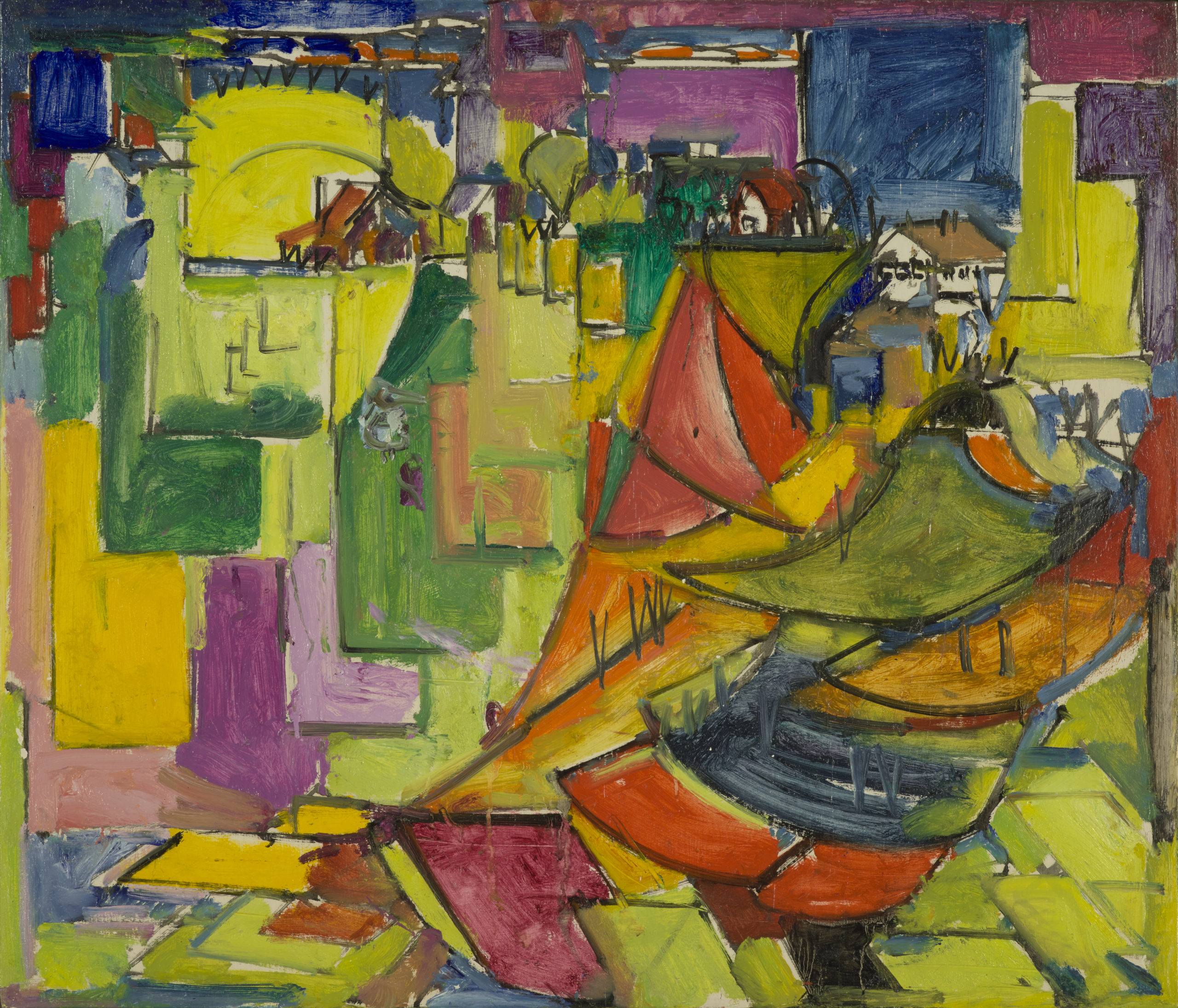
Artist Hofmann used bright colors and abstraction in his paintings, with an emphasis on expressive brushstrokes. He was inspired by the cubist and fauvist art movements of the early 20th century. Cubist artists focused on breaking a subject into geometric shapes that appear to show the subject from multiple angles at the same time. Fauvist artists used color and expressive brushstrokes to communicate their emotions.
The landscape depicted in this painting is a skyline of small homes, with patches of color that define the areas above and below the town. Landscape has some elements of traditional landscapes as well as elements of cubism and fauvism. Hofmann created this painting during his transition from representational to abstract art.
Hofmann was born and raised in Germany, where he studied art from a young age. He moved to Paris in 1904 to continue his art education. There he met many artists, including Pablo Picasso, Georges Braque, and Robert Delaunay, who influenced his colorful, abstract art style. Hofmann moved to Munich, Germany, just before World War I. After he was disqualified from military service due to a lung condition, he opened an art school in the city. In the 1930s he began teaching art and opened art schools in California, New York, and Massachusetts. He managed his art schools until 1958, when he closed them in order to focus on painting. During his time as a teacher, he influenced the styles of numerous abstract artists. Some of the artists he taught include Frank Stella and Helen Frankenthaler, whose works can be seen in the NCMA People’s Collection.