Work of Art

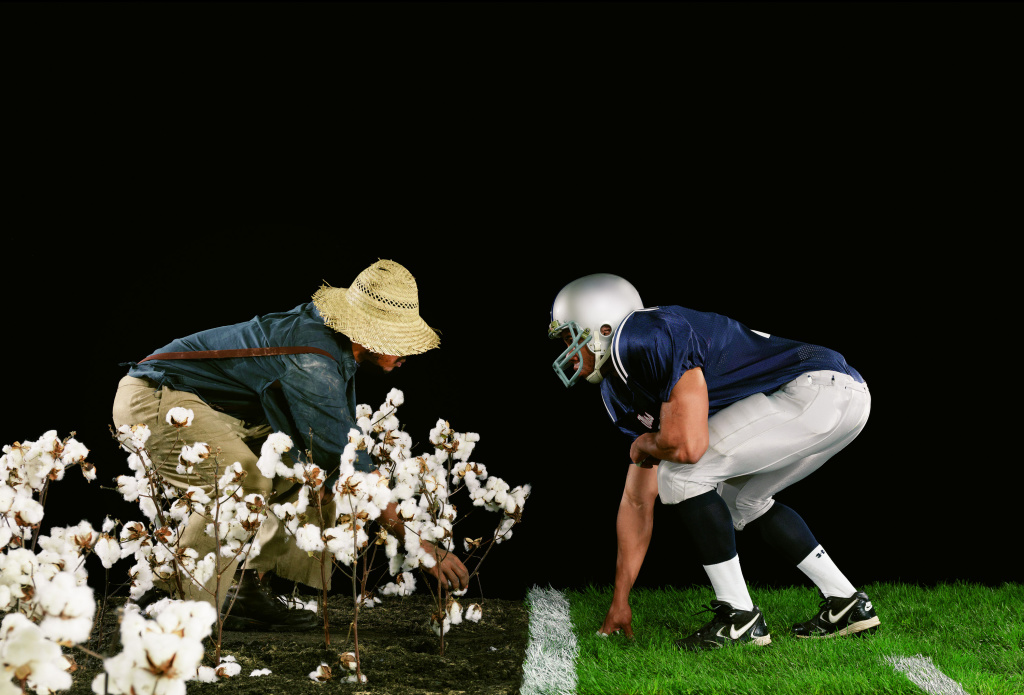
The Cotton Bowl

Created
2011
Nationality
American
Birth/Death
1976-
Dimensions
65 × 96 inches (165.1 × 243.8 centimeters)
Credit

Gift of the North Carolina Museum of Art Contemporaries

© Hank Willis Thomas

Object Number
2012.19
Culture
Classification
Photography
Department
Contemporary

Key Ideas

  • This photograph is an example of conceptual art. This type of art is about the idea behind the work, not just the image.
  • Hank Willis Thomas is an American conceptual artist. He creates art that focuses on how media and popular culture influence the way people think about identity. 
  • This work connects the past with current times. It invites viewers to consider who has power and who profits from the roles of the people shown in the photo.

Learn More

There are two main images in this work of art. One shows a person crouching to pick cotton in a field. The other shows a football player crouching on the field. The two poses look almost the same, inviting viewers to consider how the figures are alike and how they are different.


The image also makes a point about power and profit. Enslaved people worked for landowners in the past. Today athletes earn money, but they also make money for teams, brands, and advertisers. The artist asks us to think about who benefits most. 


Hank Willis Thomas is an American conceptual artist based in Brooklyn, New York. His work focuses on how media and pop culture influence the way people think about identity, especially in relation to race, history, and advertising. He often uses photographs, text, and familiar images to challenge viewers and encourage them to question what they see and believe.

My work is about framing and context. More specifically, I am fascinated with how history and culture are framed, who is doing the framing, and how these factors affect our interpretation of reality. 

Hank Willis Thomas


The Cotton Bowl is part of Thomas’s series titled Strange Fruit. The series looks at how Black bodies have been shown and remembered in American culture. The title comes from a powerful poem and a song about lynching, in which the phrase “strange fruit” refers to bodies hanging from trees. 


Another work by Thomas can be found in the NCMA Park. His interactive sculpture, Ernest and Ruth, features two large metal benches that are shaped like speech bubbles. Visitors can sit on the benches and engage with the artwork, while also connecting and talking with each other.


Tags: contemporary, American history, social studies

Read Less Keep Reading

Additional Resources

Resources for Teachers


Resources for Students

  • Watch an interview with Thomas and hear him explain his artistic intent in creating The Cotton Bowl.
  • Visit the artist’s website to see more examples of his work.
  • View a sculpture by Thomas titled The Embrace, which is a permanent memorial honoring Dr. Martin Luther King Jr. and Coretta Scott King in the city of Boston.
Read Less Keep Reading

The Cotton Bowl is from the series “Strange Fruit,” which is a “visual and conceptual explanation of the black body as spectacle and souvenir in the American popular culture.” The name “Strange Fruit” comes from a poem by Abel Meeropol (and the subsequent 1937 Billie Holiday song of the same name) written in response to a 1930 lynching in Marion, Indiana. Meeropol was disturbed by the postcard quality of photographs of the hanging. The poem began with the line “Southern trees bear a strange fruit.” In the series, Thomas reappoints souvenir-like images of racism in history, such as lynchings and fieldwork. These images of black males in servile roles were once as commonplace as our images of black males in sports are today. Looking at found images from our history, Thomas explores not only what they meant in terms of our past but also how they reflect our current collective beliefs.

The Cotton Bowl features the iconic images of a football player crouching on the yard line and the mirror image of an enslaved person crouching to pick cotton. The visual parallel makes the connection between the role of the servant and the role of the black male athlete, with the artist asking the viewer to reconsider a common historical trope and look at its relationship to the present moment in a new light. An enslaved person’s value lay in his physicality and strength, just as an athlete’s worth is tied to his physical prowess. The crouching football player is as much a part of our shared visual language as images of slavery and racism. Even though athletes are equated with success, power, and prestige, the imagery still relates to horror and racism from our past. Is the horrific being replaced by the triumphant? Or is the familiar being recast, a subconscious comfort with historical roles being put to work for those already in a position of power? An association is made between the black fieldworker who toils for the landowner’s profit and the athlete who works for the profit of the team owner and the marketing and advertising teams who rely on his image and iconography for their own success. Thomas repurposes the imagery of marketing and advertising – the glamour, gloss, and metaphor – to ask his own questions about the story popular culture is telling, and who is writing that story. By looking at past themes in a different context, Willis illuminates new relationships and meanings within the context of our present moment.


Read Less Keep Reading

Related Concepts

Learn More

Artist
Hank Willis Thomas
Share