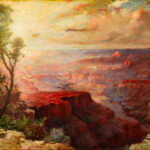
In 1911 the Santa Fe Railway wanted to increase tourism in the Grand Canyon by commissioning artists to visit and paint the area. Elliot Daingerfield was one of five American painters selected for the commission, along with Thomas Moran, Edward Potthast, Frederick Ballard Williams, and Dewitt Parshall. Over the course of a few years, Daingerfield made several trips to the Grand Canyon and created seven landscape paintings. His paintings of the Grand Canyon are some of his most famous works. These paintings include The Grand Canyon, The Genius of the Canyon, Trees on the Canyon Rim, and The Sleepers.
Daingerfield’s work is considered tonalist in style. Tonalism is an American art style that began in the 1880s and ended around 1920. It is characterized by a limited color palette, soft blurred lines, and a focus on tonal values that convey dreamlike mood and feeling. Tonalist paintings generally depict landscapes and use subtle color tones. This style of painting emphasizes evoking a feeling rather than depicting a place accurately. The colors, light, and imagery in The Grand Canyon are based on the artist’s experience of visiting the canyon and how that experience made him feel. Instead of painting a specific location in the Grand Canyon, Daingerfield combined his first impressions and memories of the natural scenery and its intense colors.
Art is the principle flowing out of God through certain men and women by which they perceive and understand beauty. Sculpture, architecture, painting, and music are the languages of the spirit.
Elliott Daingerfield
Daingerfield grew up in Fayetteville, North Carolina, during the final years of the Civil War. He later moved to New York City. Throughout his career he spent most of each year working at his art studio in New York and spent his summers working at his art studio in Blowing Rock, North Carolina.
tags: horizon, landscape, light, nature, earth science