Marsden Hartley was a painter and poet who grew up in Maine. He played a key role in the development of American modernism in the early 20th century. When he moved to Berlin in 1913, the city was a creative center for artists to experiment and exchange ideas. There he met and was inspired by Wassily Kandinsky and the German expressionist group Der Blaue Reiter.
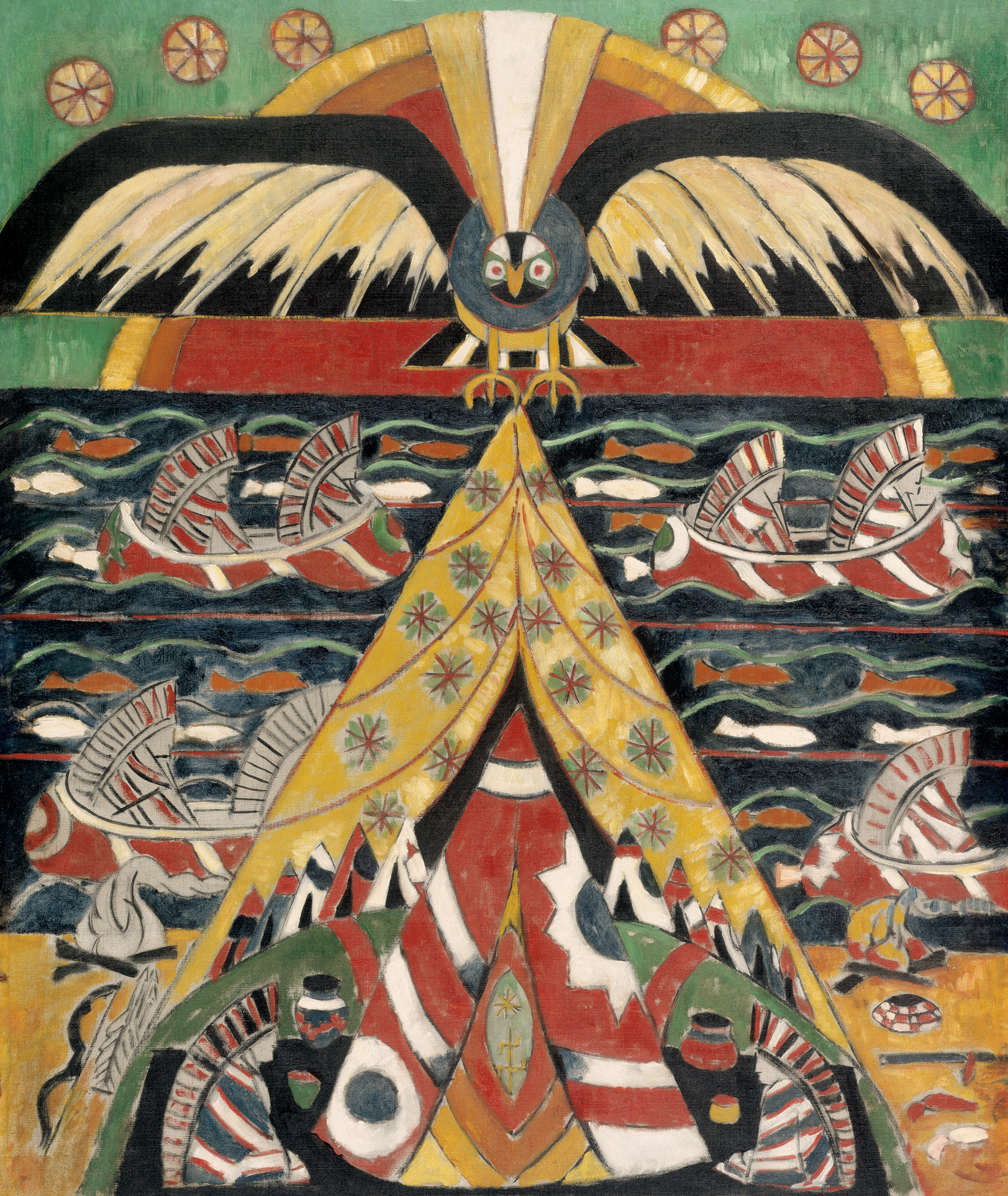
Indian Fantasy is part of a series of paintings Hartley created after seeing a collection of American Indian artifacts at the Berlin Ethnographic Museum. He painted the Amerika series as a way to gain the acceptance of the German avant-garde. Many European modernist painters were using imagery from the arts and cultures of Africa and the Pacific Islands in their work. Hartley tried to set his work apart by associating his American heritage with the culture of Indigenous American peoples. He combined American Indian imagery with his stylistic take on German expressionist paintings and German folk art. While the artist expressed admiration for these cultures, he did not belong to them. The imagery in his work (tipis, canoes, figures wearing headdresses) is considered to be a form of cultural appropriation.
Hartley painted Indian Fantasy in Berlin in 1914, the same year in which World War I began. The painting uses modernist conventions, including vibrant colors, bold brushstrokes, and abstract forms. The artist used pattern through the repetition of shapes and colors to create a composition of near symmetry. This means that the left and right sides of the painting are similar but not an exact reflection of each other.
This work depicts a romanticized scene with an American Indian theme that would have appealed to Hartley’s German viewers. Since the 18th century, American “Wild West” themes and stories about “the American Indian” have been popular in German culture. Indigenous American peoples have often been portrayed in literature, film, and art based on fantasy and cultural stereotypes.
The war forced Hartley to return to America in 1915, and he stopped painting in his former abstract style. He met artist Man Ray in New York City a few years later and briefly experimented with creating dada art. He went on to work and travel all over the world, painting landscapes, portraits, and still lifes.
tags: animals, pattern, symbolism, shapes