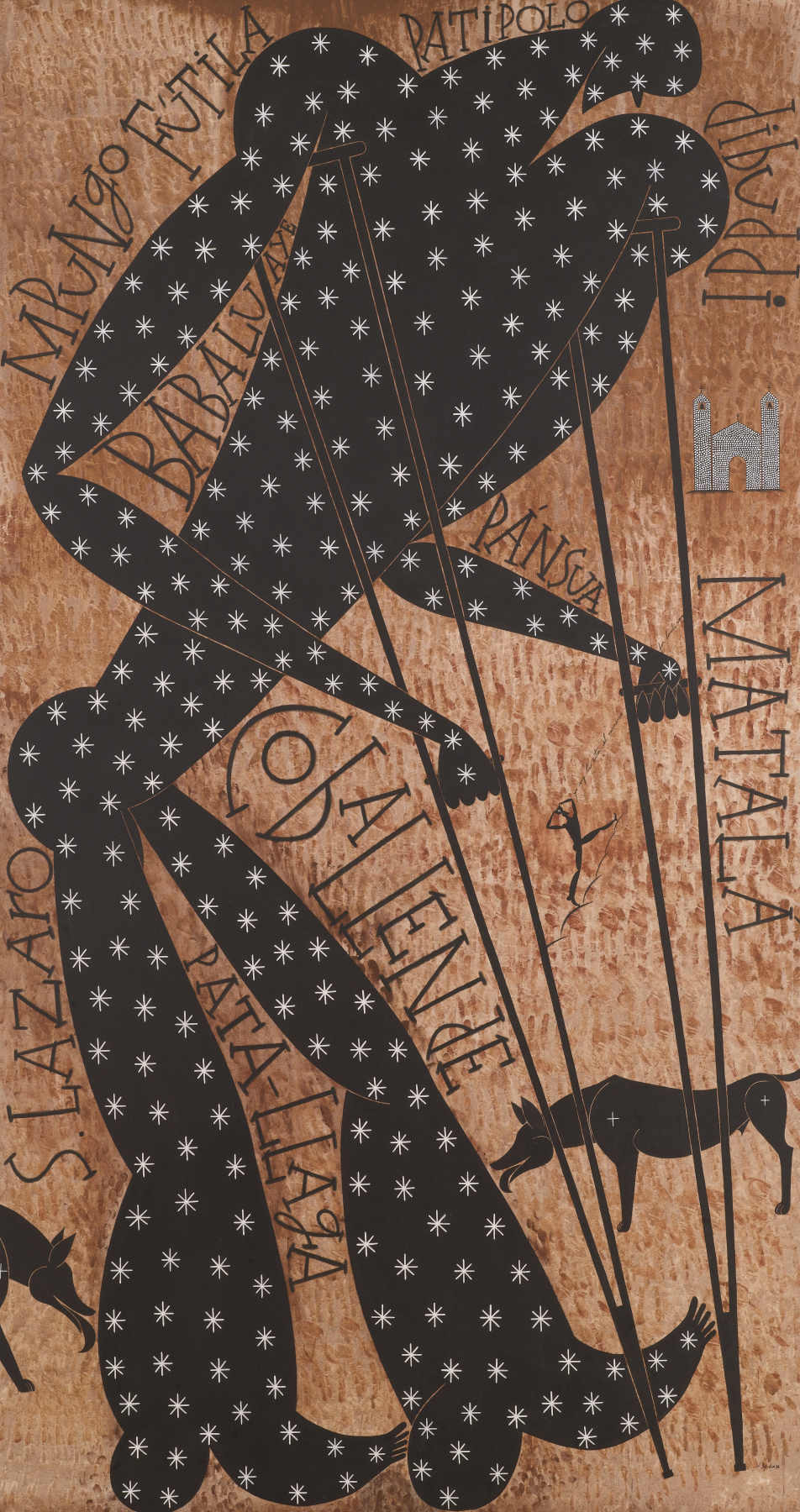
José Bedia’s art reflects his Cuban heritage and celebrates the cultures of Indigenous peoples in Latin America, Africa, and North America. Bedia explores the themes of identity and exile in his artwork, with a focus on his Palo Monte religion. Palo Monte is an Afro-Cuban religion with strong links to Native American beliefs. The practice of Palo Monte began in Cuba. It blends Catholicism, Kongo, and Native American religions and their gods, orishas, and saints. San Lázaro is a combination of the Catholic Saint Lazarus and the Orisha Babalu Aye (baba-loo eye-ay).
This painting features the different Palo names that represent San Lázaro. He is depicted as a dark figure on crutches. His body is covered in stars that represent his diseased skin, and his guide dogs are licking his wounds. San Lázaro is regarded as a humble saint of health and healing who soothes the sick, especially immigrants and people living in poverty. He is also known as the “god of crossroads” who guides people in making difficult decisions. San Lázaro’s comforting words appear in the middle of this painting, in Spanish: “Yo soy la ruta, el camino por donde vas.” The English translation of this phrase is “I am the way, the path to get you there.”