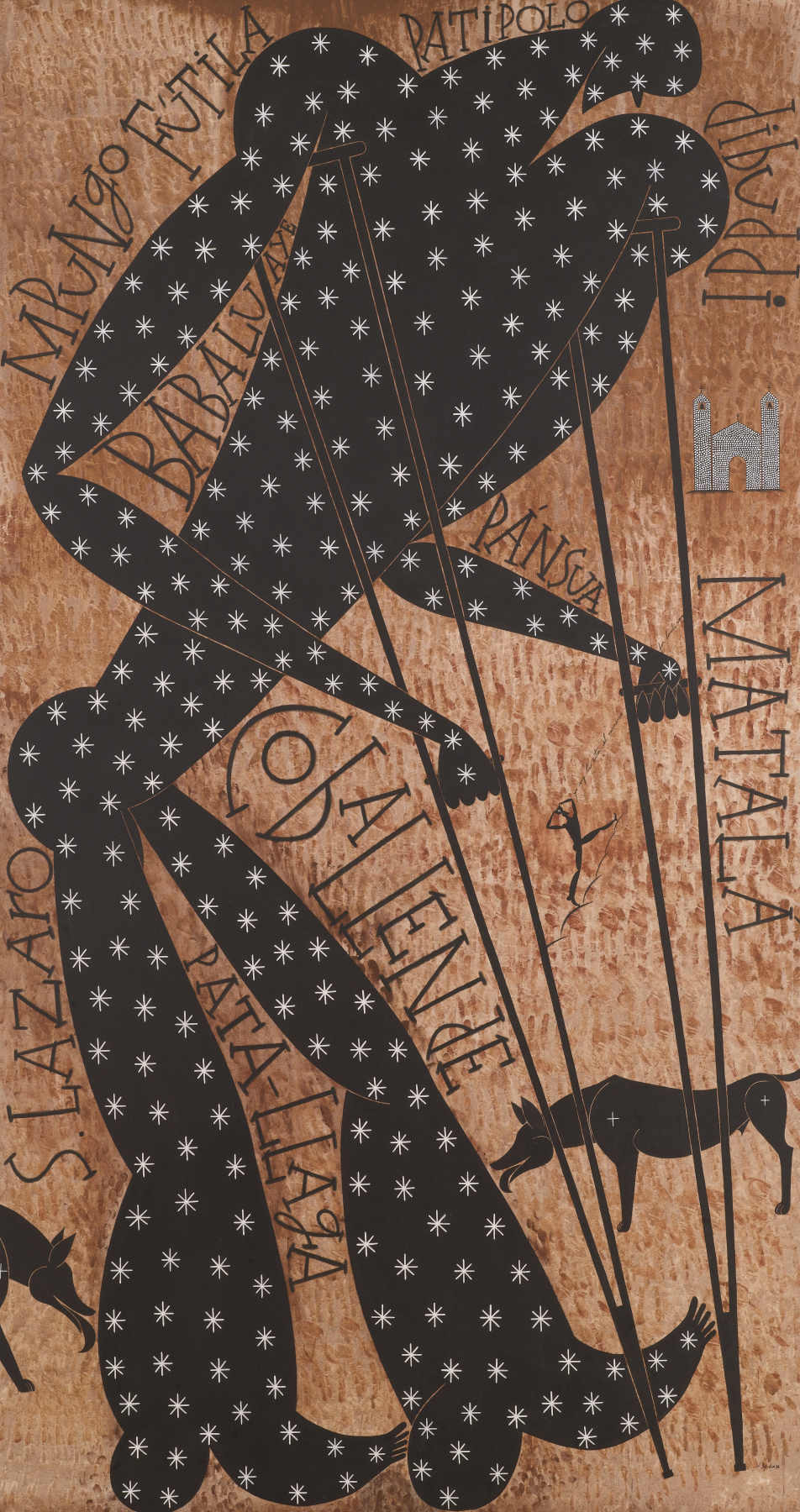
José Bedia’s art reflects his Cuban heritage and celebrates the cultures of Indigenous peoples in Latin America, Africa, and North America. Bedia explores the themes of identity and exile in his artwork, with a focus on his Palo Monte religion. Palo Monte is an Afro-Cuban religion with strong links to Native American beliefs. The practice of Palo Monte began in Cuba. It blends Catholicism, Kongo, and Native American religions and their gods, orishas, and saints. San Lázaro is a combination of the Catholic Saint Lazarus and the Orisha Babalu Aye (baba-loo eye-ay).
En este cuadro aparecen los diferentes nombres de Palo que representan a San Lázaro. Se le representa como una figura oscura con muletas. Su cuerpo está cubierto de estrellas que representan su piel enferma, y sus perros guía están lamiendo sus heridas. San Lázaro es considerado un humilde santo de la salud y la curación que alivia a los enfermos, especialmente a los inmigrantes y a las personas que viven en la pobreza. También se le conoce como el "dios de las encrucijadas" que guía a las personas en la toma de decisiones difíciles. Las reconfortantes palabras de San Lázaro aparecen en el centro de este cuadro, en español: "Yo soy la ruta, el camino por donde vas". La traducción al español de esta frase es "Yo soy la ruta, el camino por donde vas".