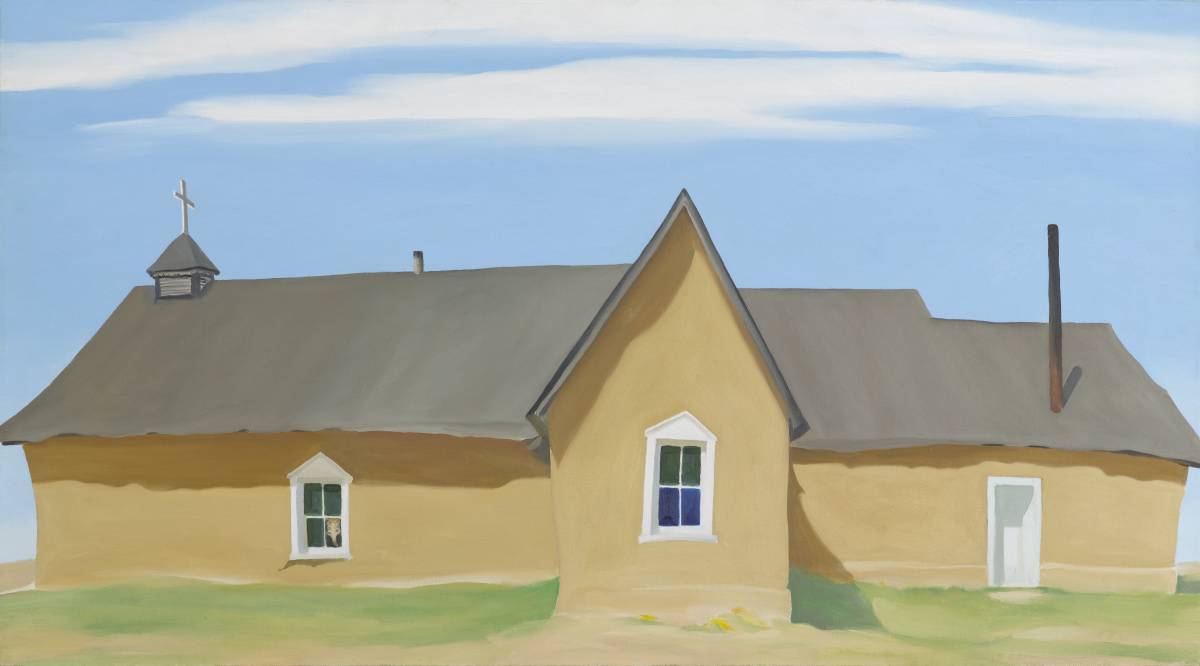
Georgia O’Keeffe saw this church during her frequent travels to New Mexico. She wrote about the poverty in the area, describing the simple church as “so typical of the difficult life of the people.” Her painting of the Church of Santo Niño in the town of Cebolla emphasizes the abstract qualities of the region’s adobe architecture with its simplified, flat planes and sun-bleached color palette.
Adobe was used by the Pueblo Indians long before colonization. Adobe bricks are made by hand from a sun-dried mixture of dirt, water, and straw. This organic building material helps maintain comfortable indoor temperatures in the desert’s extreme weather conditions. The adobe church depicted in this painting was literally formed out of the earth. It is a structure that blurs the boundary between natural and human-made.
O’Keeffe was a successful modernist painter. She trained in realism and still life. She defined her own style, however, while she was studying under the painter Arthur Wesley Dow. Her most famous works are her large-scale paintings of flowers, bones, and desert landscapes. O’Keeffe first visited New Mexico in 1929 and began spending her summers there. She said she was fascinated by the landscape and the Native American and Hispanic cultures. She moved to New Mexico permanently in 1949.