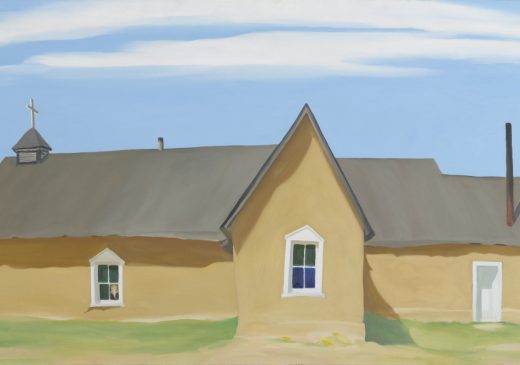
O’Keeffe was a successful modernist painter. She trained in realism and still life. Her most famous works are her large-scale paintings of flowers, bones, and desert landscapes. O’Keeffe first visited New Mexico in 1929 and began spending her summers there. She said she was fascinated by the landscape and the Native American and Hispanic cultures. She moved to New Mexico permanently in 1949.
Georgia Totto O'Keeffe (November 15, 1887 – March 6, 1986) was an American modernist painter and draftswoman whose career spanned seven decades and whose work remained largely independent of major art movements. Called the "Mother of American modernism", O'Keeffe gained international recognition for her paintings of natural forms, particularly flowers, hills and desert-inspired landscapes, which were often drawn from and related to places and environments in which she lived. Although she was a figure associated with interpretations regarding feminism, she did not want to be seen as a "woman artist", she wanted to be seen as an artist.
From 1905, when O'Keeffe began her studies at the School of the Art Institute of Chicago, until about 1920, she studied art or earned money as a commercial illustrator or teacher to pay for further education. Influenced by Arthur Wesley Dow, she began to develop her unique style through her watercolors during her studies at the University of Virginia and, more dramatically, through the charcoal drawings she produced in 1915 that marked her move toward abstraction. Alfred Stieglitz, an art dealer and photographer, held an exhibit of her works in 1916. Over the next couple of years, she taught and continued her studies at the Teachers College, Columbia University.
In June of 1918 O’Keeffe was invited by Stieglitz to live and work in New York City and accepted this invitation as well as his offer to underwrite her year of painting in the city. She resigned from teaching at West Texas State to do so. Stieglitz and O'Keefe developed a professional and personal relationship that led to their marriage on December 11, 1924. In New York, O’Keefe created many reflections of her perception of the city through oil paint, charcoal, pastel, and watercolor. She looked back fondly at her pieces from this time, calling them ‘My New Yorks’. O'Keeffe created many forms of abstract art besides those of the city, including close-ups of flowers, such as the popular Red Canna paintings.
O'Keeffe and Stieglitz lived together in New York until 1929, when O'Keeffe began spending part of the year in the Southwest, which served as inspiration for her paintings of New Mexico landscapes and images of animal skulls, such as Cow's Skull: Red, White, and Blue (1931) and Summer Days (1936). She moved to New Mexico in 1949, three years after Stieglitz's death in 1946, where she lived for the next 40 years at her home and studio or Ghost Ranch summer home in Abiquiú, and in the last years of her life, in Santa Fe. In 2014, O'Keeffe's 1932 painting Jimson Weed/White Flower No. 1 sold for $44,405,000—at the time, by far the largest price paid for any painting by a female artist. Her works are in the collections of several museums, and following her death, the Georgia O'Keeffe Museum was established in Santa Fe.