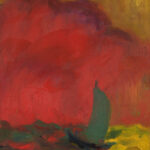
This painting was inspired by the artist’s memory of a terrifying trip crossing the Kattegat (a waterway between Sweden and Denmark) around 1910. “This day,” he explained, “has remained so fixed in my memory, that for years afterwards all my paintings of the sea consisted of wildly heaving green waves and only a little edge of yellow sky on the upper fringe.”
Emil Nolde was a German artist and one of the first expressionist painters. He is best known for his expressive color choices. His work communicates his emotions rather than depicting realistic-looking scenes. Nolde’s heavy brushwork and use of color in this painting communicates how he felt in a moment at sea when he feared for his life. The experience affected him so deeply that “rough waters” became a recurring theme in his paintings. This is one of many works he created based on that event.
A group of German artists known as Die Brücke (translated “The Bridge”) admired Nolde’s style and invited him to join their group. Die Brücke played an important role in the evolution of modern art and in the creation of expressionism in the 20th century. Nolde left the group after a year and a half, and the remaining members moved to Berlin around 1911.
Nolde was an anti-Semite and supporter of the Nazis. Because Adolf Hitler rejected all forms of modern art as “degenerate,” the Nazi party officially condemned Nolde’s work. They featured his work in the Degenerate Art exhibition in 1937. This Nazi exhibition intended to shame what they considered “bad art,” which was mostly modern work. The Nazi party strongly disapproved of expressionist art. More than 1,000 of Nolde’s works were removed from German museums. He was forbidden to produce any paintings during World War II.
tag: weather