Jacob Lawrence was one of the first nationally recognized African American artists. His paintings depicted African American historical figures and contemporary life. He called his style “dynamic cubism.” He was inspired by his environment growing up in Harlem during the Great Depression.
All these people on the street, various colors, so much pattern, so much movement, so much color, so much vitality, so much energy.
Jacob Lawrence
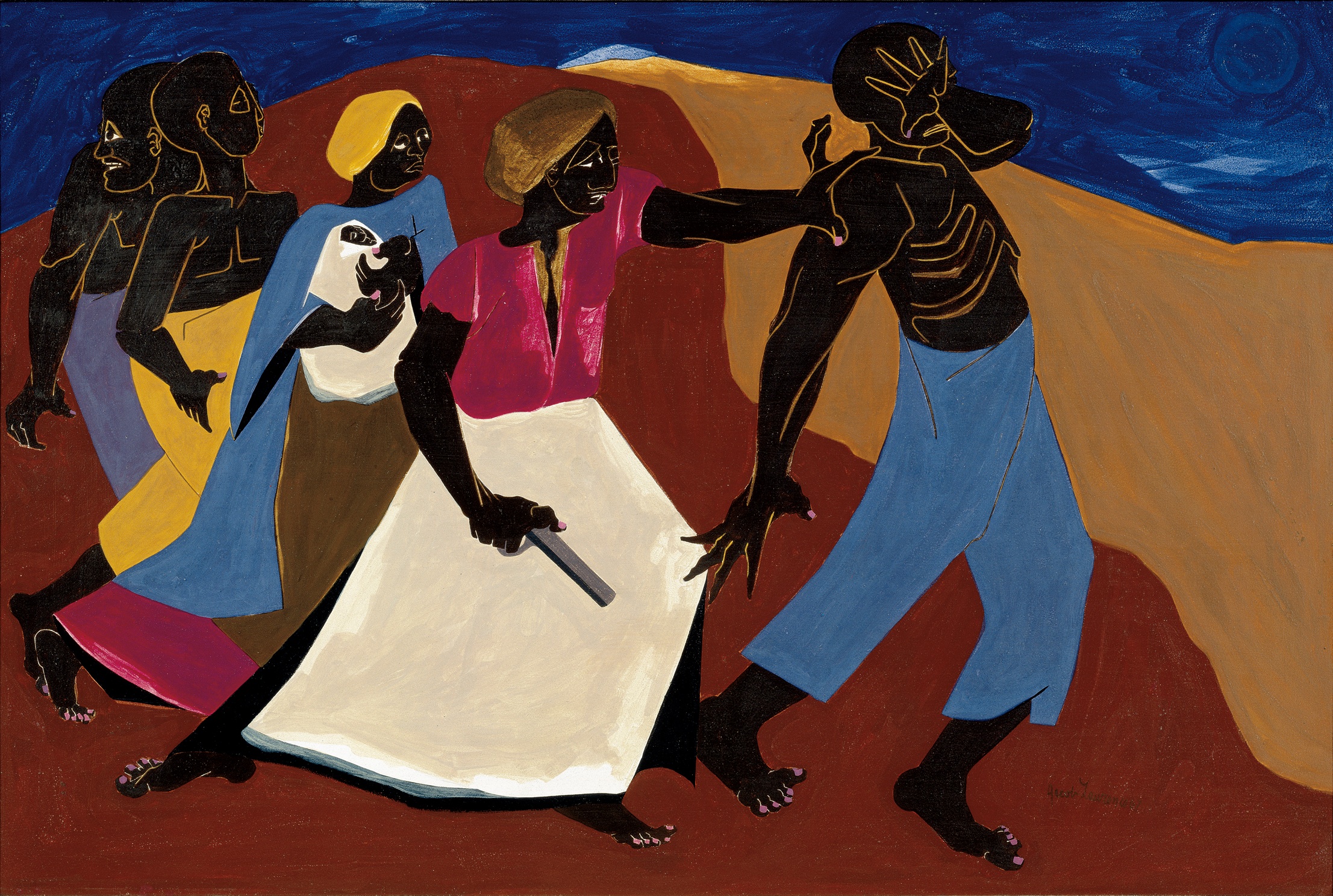
Forward depicts Harriet Tubman leading a group of enslaved people to freedom. She is holding a revolver and urging the group forward. The figures surrounding her are shown to have expressions and gestures of both fear and resolution. In 1849 Tubman escaped enslavement in Maryland using the Underground Railroad. She returned to lead other enslaved people to freedom. According to her records, she rescued approximately 70 people during roughly 13 trips. She was an abolitionist, Civil War spy, and supporter of women’s suffrage. Lawrence completed this painting of Tubman in 1967 during the Civil Rights Movement. He portrayed Tubman as an example of moral courage and self-determination.
Lawrence lived in Harlem near the end of the Harlem Renaissance. This was an early 20th-century art movement in which New York City’s Harlem neighborhood became a Black cultural center. The Harlem Renaissance encouraged the creation of literature, music, stage performances, and art that celebrates Black culture. As a teenager Lawrence attended art classes taught by Charles Alston. Alston encouraged him to attend the Harlem Community Art Center, which was headed by Augusta Savage. Alston and Savage were American artists associated with the Harlem Renaissance. Savage helped Lawrence secure a position with the Works Progress Administration (WPA), where he met his wife Gwendolyn Knight Lawrence.
Lawrence’s best-known work is The Migration Series. It comprises 60 painted panels that depict the Great Migration. The Great Migration was the movement of six million African Americans out of the rural South to the industrialized cities of the North. Black Americans moved to escape racism and violence and to find better jobs and opportunities. Lawrence’s parents relocated from the South to the Northeast during the Great Migration.
I do not look upon the story of the Blacks in America as a separate experience to the American culture but as a part of the American heritage and experience as a whole.
Jacob Lawrence
In 1946 artist Josef Albers invited Lawrence to teach a painting course at Black Mountain College, a liberal arts college near Asheville, North Carolina. The school closed in 1957, but while it was open it emphasized the importance of the arts in learning. Lawrence and his wife were intrigued enough by Albers to risk leaving their home in Brooklyn, New York, to spend two months in the segregated South. Lawrence taught a painting course during the school’s 10-week Summer Institute. While Albers taught at the college, Gwendolyn sat in on his classes, studied sculpture, and taught a modern dance class.
tags: landscape, force, heroine, narrative, color