Louis Rémy Mignot was a 19th-century American painter. He was born in Charleston, South Carolina. He was the only Southerner among the Hudson River School. The Hudson River School was an art movement of the mid 19th century supported by a group of landscape painters. These artists painted landscapes of the mountains of New York and surrounding areas. Hudson River School painters created detailed, realistic-looking landscapes. Their art was influenced by romanticism, an art movement that encouraged the appreciation of nature. Their paintings portrayed idealized scenes of country life in which humans live peacefully with nature. Hudson River artists often painted panoramas, or wide views, of landscape scenes. The original members of the Hudson River School focused on depicting the Hudson River Valley and the Catskill, Adirondack, and White Mountains. Later painters of the movement depicted New England, Eastern Canada, the Western United States, and South America.
Mignot joined fellow painter Frederic Church on a four month trip to Ecuador in 1857. Church focused on painting the Andes mountains, while Mignot was drawn to the low-horizon river landscapes. He created many travel sketches during this trip that he later used to compose landscape paintings. As a result, his paintings may not depict specific locations. They are more likely composites, or combined images, of multiple places he observed.
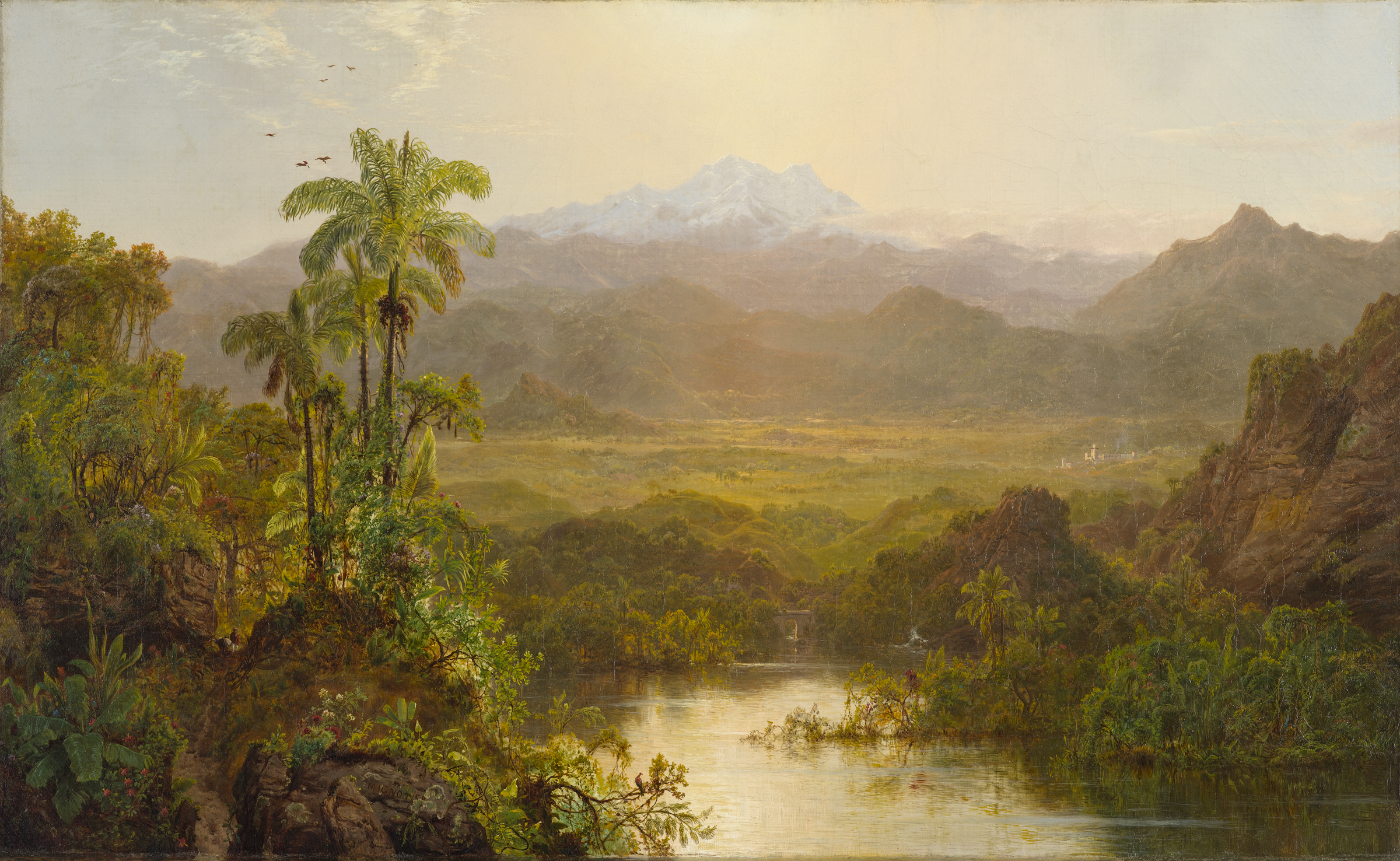
Landscape in Ecuador is one of the paintings Mignot created using his travel sketches. In this painting he depicts a panorama view, with a river in the center-foreground and a verdant jungle and palm trees on each side. There is a viaduct or bridge that crosses the river in the distance. Beyond the viaduct are foothills leading towards a colonial town. Beyond the town are ascending ridges that lead to a snowcapped volcano. The volcano, known as Capac Urcu (Almighty Mountain) by Incans, was named Al Altar by Spanish colonizers who thought it looked like a large cathedral.
Following the outbreak of the Civil War in the United States, Mignot raised money by selling his artwork and moved to England in 1862. He set up an art studio in London and traveled between London and Paris to work and exhibit. His work was accepted into the 1870 Paris Salon. Mignot fled France in 1870, at the beginning of the Franco-Prussian War. He went back to England and died from smallpox at age 39.
tags: formas del terreno, ecosistemas, nubes, ciencias de la tierra