

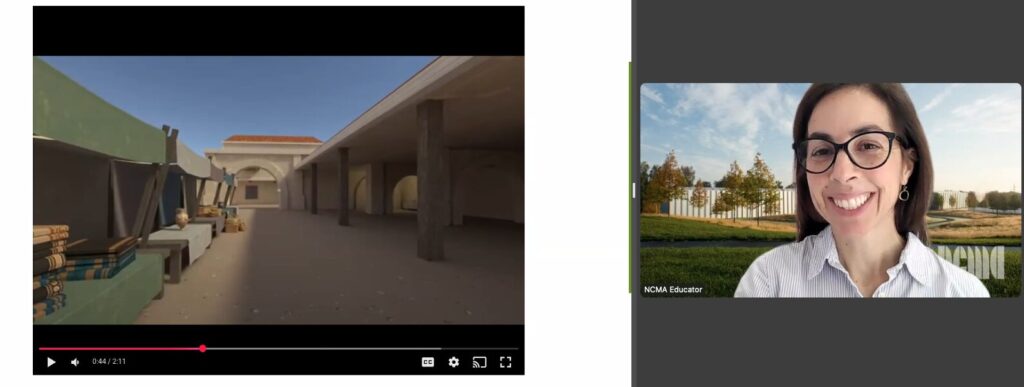
A museum educator shows students how to use the virtual archeological site to find ancient Greek objects from the collection.
Virtual Field Trips (VFT) programs for 6th-8th graders encourage close looking, communication, and collaboration using inquiry-based strategies.
Read about our cross-disciplinary options below:
Elements & Principles of Art
Color
Students will explore works of art from the NCMA’s permanent collection and discuss color as an element of art. Students will learn how color combinations (color schemes) are chosen by artists, and why they work, as well as how color temperature and saturation are used.
Focal Point
Students will look carefully at objects from the museum’s permanent collection to explore how artists use the principle of focal point. Students will discover how artists emphasize their works’ most important part(s) through placement, contrast, and converging lines to move the viewers’ eyes where they want them to go.
North Carolina Standards Connections to Visual Art
Selfies and Usies
What can you tell about a person just by the way they present themselves visually? While exploring historical and contemporary portraits from the NCMA’s permanent collection, and what artists and sitters choose to present in these portraits, students will ‘read’ the stories the artists are telling about the sitters.
North Carolina Standards Connections to Visual Art, Social Studies, and English Language Arts
What's a Curator of Ancient Collections?
Students will look carefully at the Museum's Ancient Egyptian Gallery and explore the work of a museum curator. They will hear from Caroline Rocheleau, one of the Museum's Curators of Ancient Collections, about what makes her career unique and what students can do to work toward a career in museum curatorial work.
Choose Your Own Adventure: Group Narrative Writing
Students will view and discuss many works of art from different areas of the NCMA’s permanent collection. Together, students will select artworks that represent key components of a narrative: characters, setting, conflict, and solution, and discuss a possible plot to create a collective story around their chosen works of art.
North Carolina Standards Connections to English Language Arts and Visual Art
Artists as Real-World Problem Solvers
Students will engage with objects from the museum’s collection and explore their uses of:
- geometry, area & perimeter, ratios, and coordinate planes (for Math 6, and Math 6+)
- geometry, scale drawing and ratios, coordinate planes, and congruence through transformations. (for Math 7, Math 7+, Math 8, and Advanced/Compacted Math)
Students will have the opportunity to solve the mathematical problems that artists, curators, and art handlers might deal with in their everyday jobs. Please have calculators available for students, if necessary. This program comes with an optional Post-Virtual Field Trip Art Kit. Order yours at registration.
North Carolina Standards Connections to Math, Visual Art, Social Studies, and English Language Arts
Forces and Motion
Students will use their five senses to carefully observe three works of art from the NCMA’s permanent collection, looking for evidence of forces that cause objects to move. Students will explore how artists use “tricks” to imply movement in art that doesn’t actually move, comparing that to a kinetic sculpture that does move.
North Carolina Standards Connections to Science, Visual Art, and English Language Arts
Weather
Students will use their five senses to carefully observe three works of art from the NCMA’s permanent collection, looking for evidence of temperature, wind, and precipitation to determine the weather that each artist shows and explore how each weather condition is created.
North Carolina Standards Connections to Science, Visual Art, and English Language Arts
Mesoamerican Ballgame
Using visual analysis, students will examine two different objects from the Ancient Americas collection and think about the role of sports in community. Using what they learned, students will have the opportunity to work together and design their own game, continuing a tradition of community and play. Collaboration with your school’s PE teacher is recommended for this program, but not required.
North Carolina Standards Connections to Visual Art, Social Studies, Physical Education, English Language Arts, and International Society for Technology in Education (ISTE)
Animal Masquerades
Using visual analysis, students will examine masks from two different West African cultures featuring animal imagery, and learn about their uses and symbolism. Using what they learned, students will have the opportunity to design animal imagery that represents them.
North Carolina Standards Connections to Visual Art, Social Studies, and English Language Arts
Discovering Día de los Muertos
Students will observe an ofrenda, one aspect of the Mexican celebration of Día de los Muertos and discover how the symbols used in the ofrenda celebrate and remember ancestors while connecting to indigenous Mexican cultural practices shown through museum objects. This program comes with an optional Post-Virtual Field Trip Art Kit. Order yours at registration.
North Carolina Standards Connections to Visual Art, Social Studies, and English Language Arts
Our State: NC Art and Artists
Students will connect with their state through maps, museum objects about NC by NC Artists, and their own experience to consider how pastimes might be different in the three geographic regions of the state.
North Carolina Standards Connections to Social Studies, Visual Art, and English Language Arts
Explore Ancient Cultures: Egypt, Greece, or Rome
What can we learn about ancient cultures by observing objects made by ancient people? In this Virtual Field Trip, students gain insight into Ancient cultures by exploring objects from the NCMA’s permanent collection as primary sources. Students will be led through a virtual archaeological site to search for museum objects and observe them using Sketchfab 3-D imagery. These programs come with an optional Post-Virtual Field Trip Art Kit; order yours at registration.
North Carolina Standards Connections to Social Studies, Visual Art, and English Language Arts
The Stories Art Can Tell ...
In each of these Virtual Field Trips, students will explore three works of art from the NCMA’s permanent collection featuring artists from a group that museums have historically excluded or under-represented. Through reading the works by different featured artist groups, students will practice the social emotional learning competencies of self and social-awareness and relationship skills.
Featuring Black Artists
Students will “read” works of art from the permanent collection by African American artists and explore how each artist tells a story of Black History through their unique use of art elements and media.
North Carolina Standards Connections to Social Studies, Visual Art, English Language Arts, and Social Emotional Learning
Featuring Indigenous Artists
Students will “read” works of art from the permanent collection by Indigenous North American artists and explore how each artist tells a story of Native American past, present, and future. Students will discover how each artist uses their media and scale to elevate and point to the universality of these stories.
North Carolina Standards Connections to Social Studies, Visual Art, English Language Arts, and Social Emotional Learning
Featuring Latin American Artists
Students will “read” works of art from the permanent collection by Latin American artists and explore how each artist tells a story about their identity through images of place. Please have students come to their session with two pieces of paper each, any color. This program comes with an optional Post-Virtual Field Trip Art Kit. Order yours at registration.
North Carolina Standards Connections to Social Studies, Visual Art, English Language Arts, and Social Emotional Learning
Featuring Women Artists
Students will “read” works of art from the permanent collection by women artists and how each artist tells a story about their own intersecting identities through images of women. This program comes with an optional Post-Virtual Field Trip Art Kit. Order yours at registration.
North Carolina Standards Connections to Social Studies, Visual Art, English Language Arts, and Social Emotional Learning
See our Spanish Language Program Page for more details and to sign up
Historias que el arte puede contar sobre Artistas Latinos
Spanish Language Program for fluent Spanish speakers.
Exploring the Art and Language of Hispanic Artists
Bilingual Program for native English speakers learning Spanish or for native Spanish speakers learning English.