Work of Art

Afrodita Anadyomene (tipo Cirene)

Creado
late first century B.C.E.–second century C.E.
Artista
Artista romano desconocido
Dimensiones
71 3/8 x 20 1/4 x 20 pulgadas (181,3 x 51,4 x 50,8 centímetros)
Crédito

Comprado con fondos del Estado de Carolina del Norte y de la Sociedad de Arte del Estado de Carolina del Norte (legado de Robert F. Phifer)

Número de objeto
G.80.9.1
Cultura
Clasificación
Escultura
Departamento
Antiguo

Key Ideas

  • Esta es una estatua de Afrodita, la antigua diosa griega del amor y la belleza. En la mitología romana esta diosa es conocida como Venus.
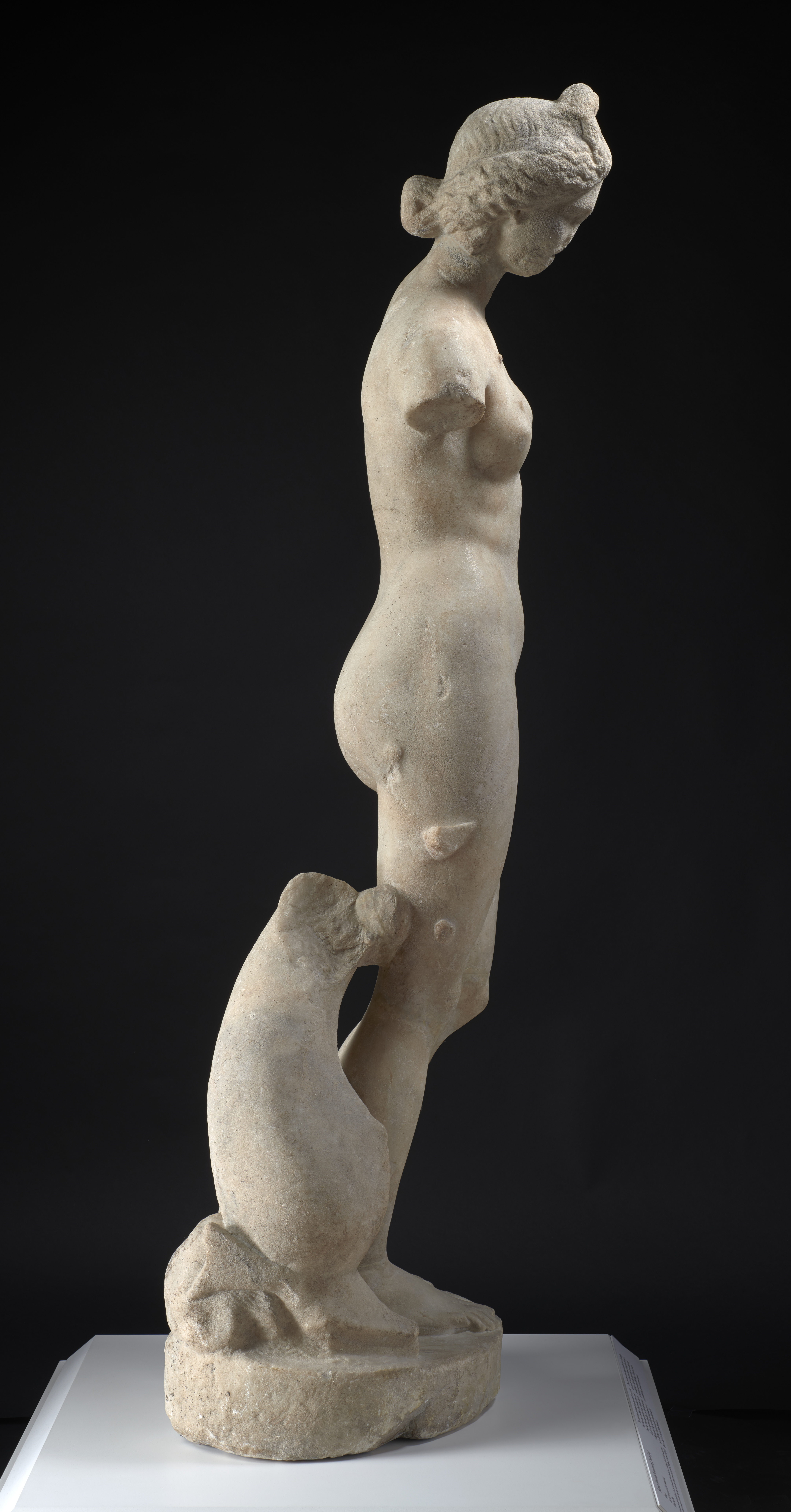
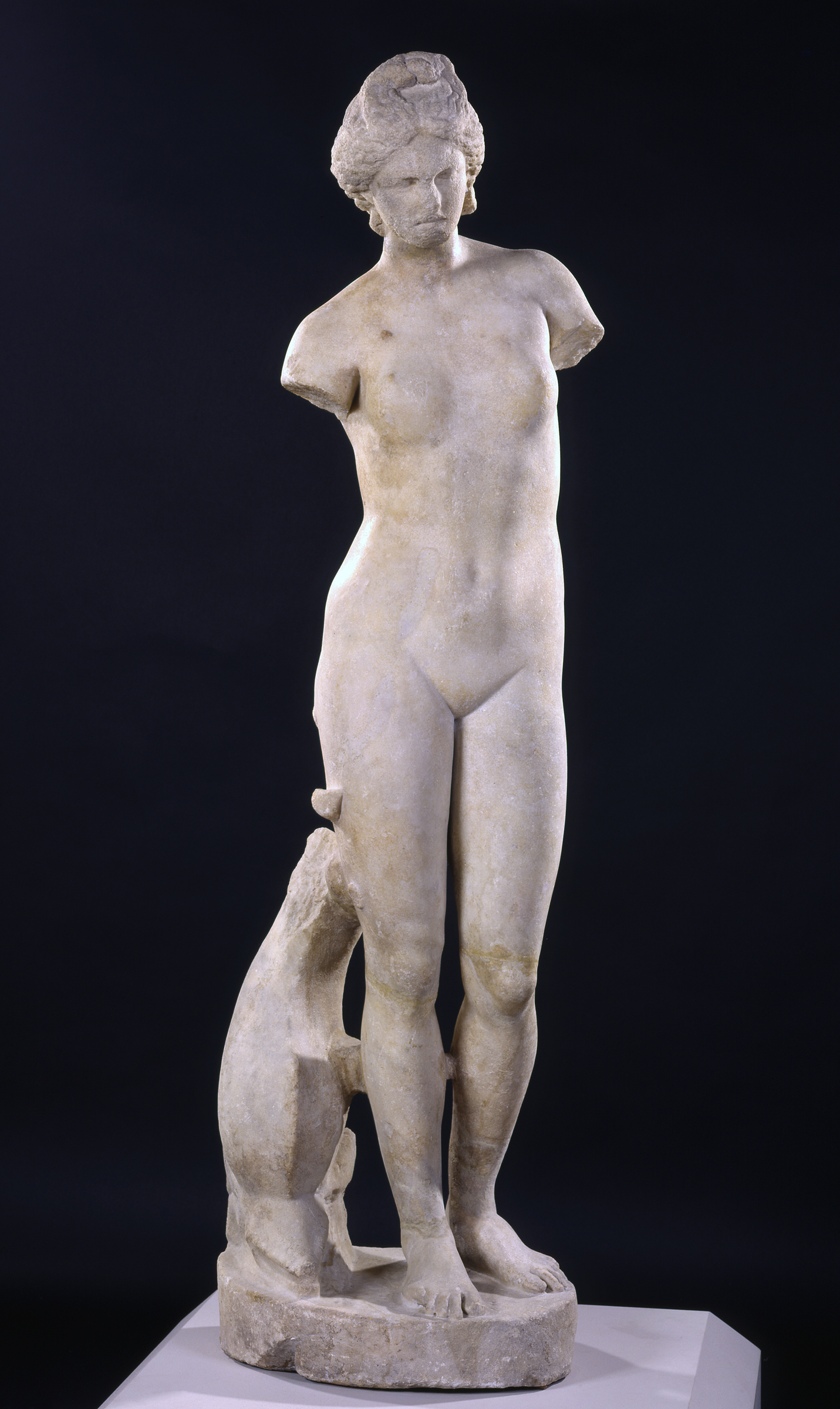
  • Las esculturas clásicas de figuras humanas suelen tener los brazos rotos o perdidos por su fragilidad. Aunque a esta estatua de Afrodita le faltan los dos brazos, los arqueólogos e historiadores pueden determinar la posición de sus brazos estudiando estatuas similares y buscando pistas (como la posición de sus hombros y los trozos de pelo que quedan) en esta estatua.
  • La estatua representa el nacimiento de Afrodita cuando sale del mar. Este origen mitológico de la diosa le da el epíteto Anadyomene (anna-die-oh-meen), que significa "surgir del mar" en griego antiguo. Aunque en la estatua no hay ninguna representación del mar en sí, éste queda simbolizado por la figura del delfín y el gesto de los brazos que le faltan a Afrodita.
  • Durante el Renacimiento, el pintor italiano Sandro Botticelli interpretó el mito del nacimiento de Afrodita en el mar y creó el famoso cuadro El nacimiento de Venus.
  • Los historiadores modernos asocian la representación de Afrodita en esta postura y estilo con la ciudad de Cirene, ya que la primera estatua de este tipo se encontró allí en 1913. Situada en el norte de África, Cirene fue una de las primeras colonias griegas. Durante el periodo helenístico (323-30 a.C.), Cirene se convirtió en el "centro intelectual" del mundo clásico.

Más información

Según la mitología griega, Afrodita, la diosa del amor y la belleza (conocida por los romanos como Venus), nació del mar. La figura del delfín junto a ella representa el mar. Afrodita está relacionada con Cirene, una ciudad del norte de África, a través de una estatua similar que se encontró allí en 1913. Esa estatua fue la primera de "tipo Cirene" que se descubrió, por lo que los estudiosos han dado este nombre a estatuas similares que se descubrieron posteriormente.

En las estatuas de figuras humanas, los brazos son elementos delicados que se rompen con facilidad. Los arqueólogos e historiadores creen que los dos brazos de Afrodita que faltan estaban doblados por el codo. Su mano derecha probablemente sostenía un mechón de pelo que caía sobre su pecho; en esta estatua se puede ver un rastro del mechón. La mano izquierda probablemente sostenía un mechón de pelo que caía justo detrás de la oreja izquierda. Fijar su cabello (o exprimir el agua de él) es un gesto apropiado para la diosa cuando sale del mar. Muchos ejemplos de este tipo de estatuas de Afrodita, conocidas con el término griego Anadyomenetodavía existen.

Además del mito del nacimiento de Afrodita del mar, existen otras versiones de su historia de origen. El autor y poeta griego Homero atribuye su nacimiento a sus padres, Zeus y Dione. El origen de Afrodita se asocia a menudo con la isla de Chipre, situada al sur de Turquía y al oeste de Siria y Líbano.de Turquía y al oeste de Siria y Líbano.

tags: proporción, equilibrio, mitología, Antigua Roma, identidad, cambio, comunicación, significado

Read Less Keep Reading

Recursos adicionales

Recursos para los profesores: 


Recursos para los estudiantes:

Read Less Keep Reading

Artista romano desconocido

G.80.9.1

This is a statue of Aphrodite, the ancient Greek goddess of love and beauty. In Roman mythology this goddess is known as Venus.
Classical sculptures of human figures often have broken or missing arms because the arms are so fragile. While this statue of Aphrodite is missing both arms, archaeologists and historians are able to determine how her arms were positioned by studying similar statues and by looking for clues (such as the position of her shoulders and the remaining pieces of her hair) on this statue.
The statue depicts the birth of Aphrodite as she rises from the sea. This mythological origin of the goddess gives her the epithet Anadyomene (anna-die-oh-meen), meaning “rising from the sea” in ancient Greek. Even though there is no depiction of the sea itself on the statue, it is symbolized by the dolphin figure and the gesture of Aphrodite’s missing arms.
During the Renaissance, Italian painter Sandro Botticelli interpreted the myth of Aphrodite’s sea birth and created the famous painting The Birth of Venus. 
The depiction of Aphrodite in this pose and style is associated with the city of Cyrene by modern historians because the first statue of this type was found there in 1913. Located in North Africa, Cyrene was an early Greek colony. During the Hellenistic period (323–30 B.C.E.), Cyrene became the “intellectual center” of the classical world.

According to Greek mythology, Aphrodite, the goddess of love and beauty (known to the Romans as Venus), was born from the sea. The dolphin figure beside her represents the sea. Aphrodite is connected with Cyrene, a city in North Africa, through a similar statue that was found there in 1913. That statue was the first “Cyrene type” statue to be discovered, so scholars have given this name to similar statues that were discovered later.
On human-figure statues, arms are delicate features that break easily. Archaeologists and historians believe that both of Aphrodite’s missing arms were bent at the elbow. Her right hand was likely holding a strand of hair that fell to her breast; a trace of the strand of hair can be seen on this statue. Her left hand likely held a lock of hair that fell just behind her left ear. Fixing her hair (or squeezing the water out of it) is an appropriate gesture for the goddess as she rises from the sea. Many examples of this type of Aphrodite statue, known by the Greek term Anadyomene, still exist.
In addition to the myth of Aphrodite’s birth from the sea, there are other versions of her origin story. The Greek author and poet Homer attributes her birth to her parents, Zeus and Dione. Aphrodite’s origin is most often associated with the island of Cyprus, located south of Turkey and west of Syria and Lebanon.
tags: proportion, balance, mythology, Ancient Rome, identity, change, communication, meaning

Comprado con fondos del Estado de Carolina del Norte y de la Sociedad de Arte del Estado de Carolina del Norte (legado de Robert F. Phifer)

late first century B.C.E.–second century C.E.

71 3/8 x 20 1/4 x 20 pulgadas (181,3 x 51,4 x 50,8 centímetros)

Escultura

Antiguo

Conceptos relacionados

Más información

A white marble sculpture of open Styrofoam takeout boxes stacked on top of a gray, rectangle-shaped base.
Work of Art

Stack

Share