North Carolina artist John Biggers was born and raised in Gastonia. His interest in art began at the Hampton Institute in Virginia, where he took an art class with a man named Viktor Lowenfeld. Lowenfeld was a Jewish refugee who was forced to leave his home due to Nazi persecution. He inspired Biggers to explore his own experiences and racial prejudice, and to embrace his African heritage. During this time Biggers became friends with artists Elizabeth Catlett and Charles White, who influenced his art style. He received a grant from UNESCO in 1957 that gave him the opportunity to travel throughout West Africa and study art and culture in different countries. This experience caused a significant shift in Biggers’s style and technique. His work began to explore the connections between African and African American cultures.
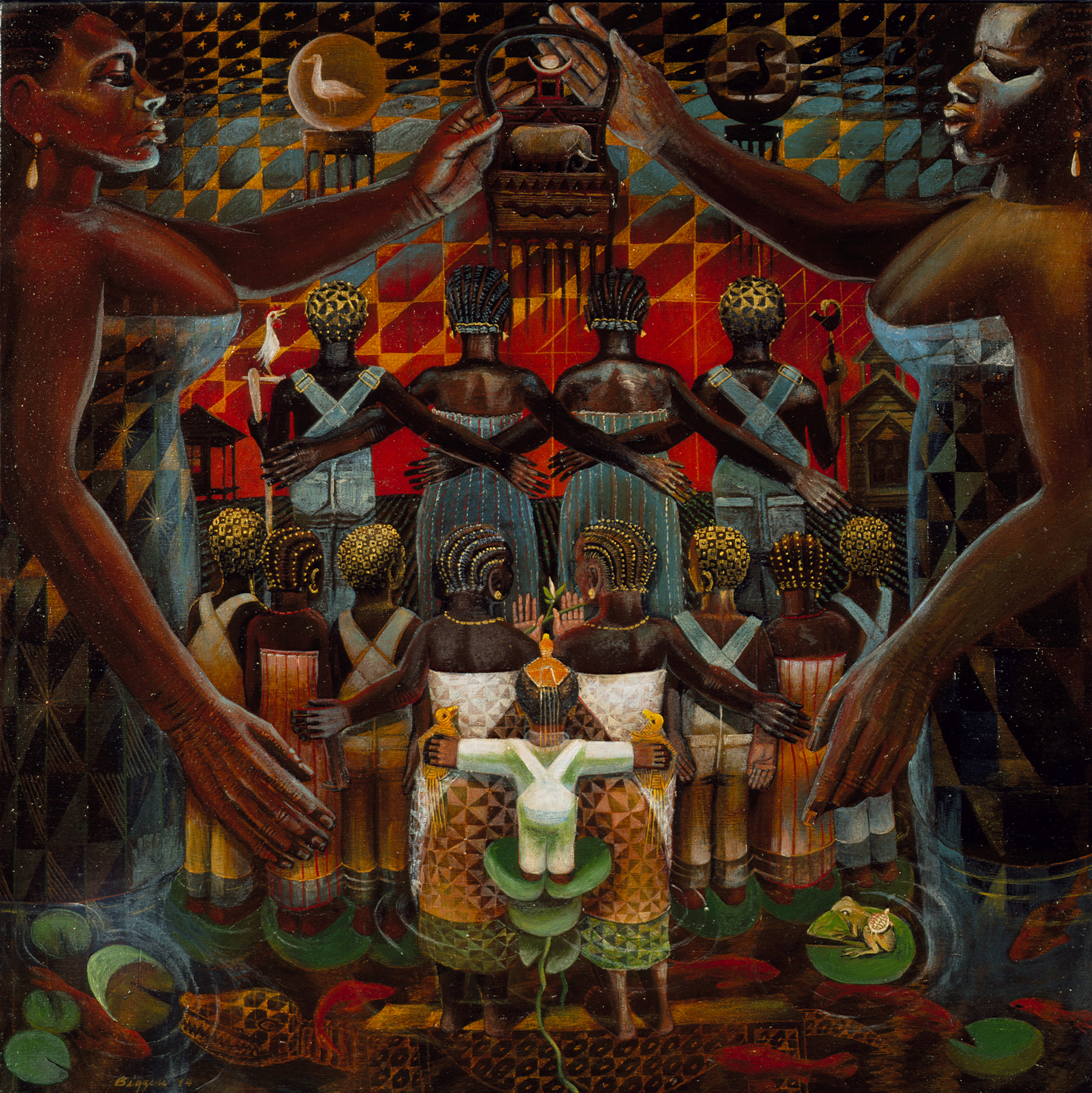
Biggers used a rich visual language in his paintings and murals, addressing the past, present, and future of Africa’s scattered children. In this symbolic painting, three generations of a Black family are coming out of a pool of water. This imagery represents birth and ritual purification. Some of the people in the painting are wearing textiles that resemble Nigerian ukara cloth. Others are wearing denim overalls. This community (framed by two monumental symbols of “Mother Africa”) represents the African diaspora and the blending of cultures and styles that resulted from the Transatlantic Slave Trade.
tags: pattern, animals, water, cycle, family, identity, interdependence, meaning, power, celebration